Raising Hell: Issue 33: And?
"Victory will be achieved when average citizens 'understand' (recognize) uncertainties in climate science; recognition of uncertainties becomes part of 'conventional wisdom'" - API memo, 1998
When Andrew McConville stood to give his closing address to a packed auditorium in the Perth Convention and Exhibition Centre, he sought to strike a tone of defiance.
The Australian Petroleum Production and Export Association’s (APPEA) three day conference ran from 14 June and brought noted public figures like Prime Minister Scott Morrison (albeit via zoom), WA Premier Mark McGowan and the Australian Conservation Foundation’s CEO, Kelly O’Shanassy to speak to a crowd of oil and gas executives.
As much as the industry association presented this gathering as an expression of consensus building, the gathering was an expression of its power and influence. During the panel discussions, participants were posed questions like “All style and no substance? WA’s onshore opportunity—what’s holding us back?” and “Is the oil and gas industry part of a net zero emission future?” Even if the words “climate change” were on everyone’s lips, no one was seriously talking about the prospect that stopping the existential threat to human life meant the end of the oil and gas sector as we know it.
Yet as McConville, APPEA’s chief executive, began to talk he made sure the message he was sending was crystal clear.
“This week we've looked the challenges facing our industry square in the face. We've stared those challenges down, and we will absolutely continue to do so,” he said.
What followed was ten minutes of pathos where McConville claimed to “speak for the bakery owner in Nowra, or the diesel mechanic in Karratha, the helicopter pilot in Gippsland”, he called on the oil and gas industry to “speak up”, he called on the industry to make themselves heard above the “very well-funded” activists who spread “misinformation” about their activities.
“APPEA is your association, and we’re here to help you to provide support and ensure that your oil and gas businesses thrive. And we just can’t be quiet anymore. We owe it to the bakery owner in Nowra. We owe it to the diesel mechanic in Karratha, and we owe it to the pilot in Gippsland to speak up.”
By the end, McConville wept.
It was a curious speech, if only because it offered an insight into the thinking of the industry at the present moment. The International Energy Association had pulled the rug from beneath it when the organisation announced in May that “no new oil and natural gas fields are needed in the net zero pathway, and supplies become increasingly concentrated in a small number of low-cost producers.” Contrary to the oil and gas industry’s assertion that it was going from strength-to-strength, it was increasingly coming under siege. Recently, APPEA’s US counterpart, the American Petroleum Institute was up in court for running a decades-long interference campaign to hide the truth about climate change, a Dutch court had ruled Shell actually had to do something about climate change, while Exxon and Chevron lost seats on their respective boards to activist shareholders.
For all the industry’s effort of late to frontline the idea that natural gas was a “transition fuel” and the “future” of the industry, at the end of the day, burning gas was still burning gas — not that this basic reality mattered much. In order to have their cake and eat it to, the industry’s consensus is that the problem isn’t the product they’re hawking, but the way they were selling it.
All of this had been made explicit in one presentation by John Scales, founder of JWS research, data merchants who provide “research-based advice to the government and business sectors in Australia, particularly on complex and challenging issues”. In one presentation, he explained how he had been working since 2018 to build a communications strategy for the industry. His advice to the industry was that it should pitch its communications towards the centre — that cluster of people in the centre of the bell curve who didn’t know much about climate change or the gas industry — rather than talking to those on the wings.
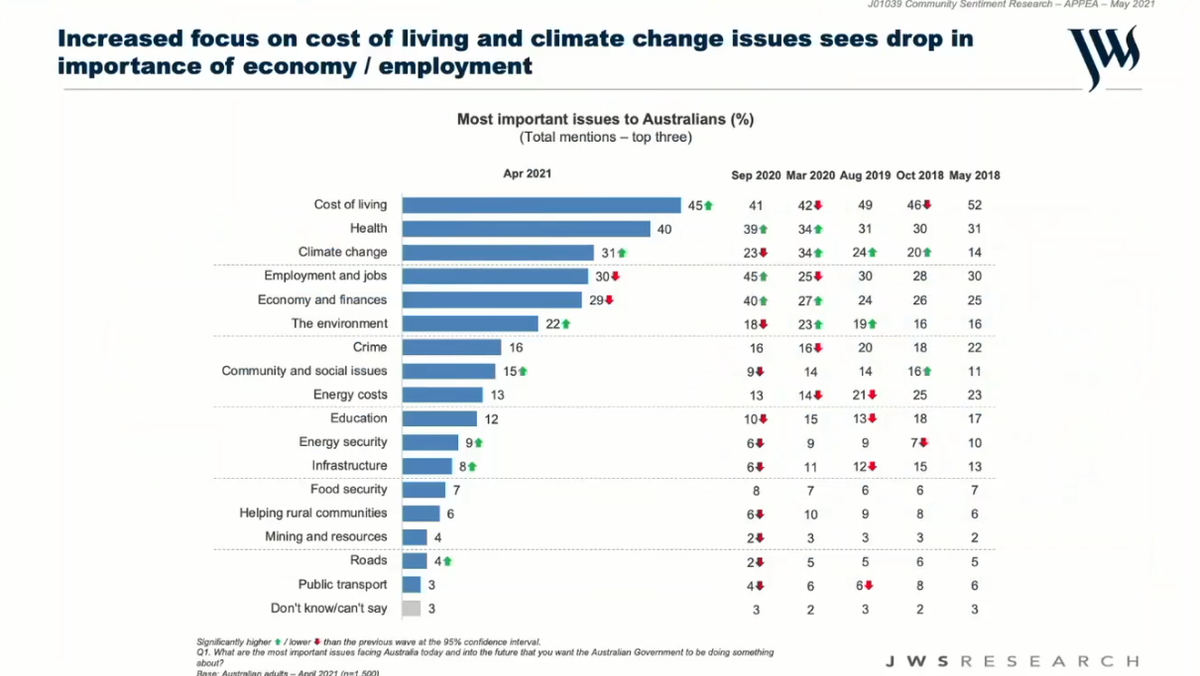
The kicker, however, was Scales’ research into what Australian's cared about:
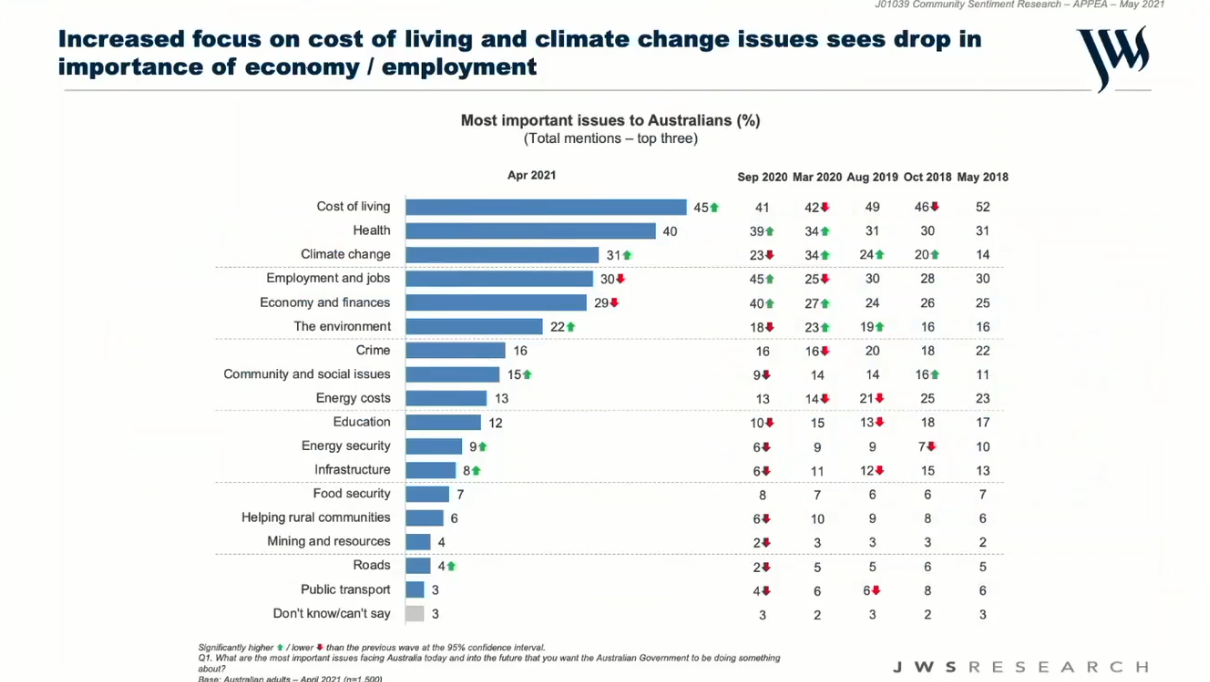
Following the bushfires — an months-long event wherein an area twice the size of Taiwan burned — the pandemic meant people came to care more worried about how they were going to pay their mortgage and whether they were going to get sick than climate change. Naturally, as Scales explained, the industry sought to cynically this trend in its public relations campaigns.
“Through this time, two key recommendations were incorporated into the program from the contemporary research, by way of continued reinforced of natural gas’s contribution to the economy and jobs, and improved appreciation of natural gas as a clean energy source,” Scales said.
The trouble now, he concluded, was that as things look better for the pandemic, people hadn’t forgotten that climate change. As the memory returned, a “spotlight back on the role and nature of gas”. In preparation for this, Scales said the industry was already gearing up to go harder in its communications strategy.
“So indications are that this time we need to pivot and adapt further and probably more proactively in order to maintain the high ground and keep those detractors at bay,” he said.
It was this communications strategy that I ran into face-first during while working on a story this last fortnight — which is partly why I’m talking about this now. While I can say no more until it, there is still a lot of insight to be gleaned from knowing McConville used the word “speak” 29 times in his closing address. Climate change may represent an existential threat to human existence but to any impartial observer, it’s pretty clear that from this point on the plan among the fossil fuel sector is to speak up — and speak over — any mention of how oil and gas companies are making it happened — or actively helped to cover it up.
For the Fortnight: July 21 to August 3
Reporting In
Where I recap what I’ve been doing this last fortnight so you know I’m not just using your money to stimulate the local economy …
- There’s a funny thing when you’re freelancing: yes, it’s all feast and famine but even when things have come roaring back after a slow period, it still takes time for the production work to get done and for the stories you are working on to hit print. At the time of writing, I have two stories with editors, one working draft on an investigative feature, two commissions in chain, one pitch I have yet to hear back on and all while spending two days this week sitting through final submissions in the Wayne Fella Morrison inquest. Outside this, I pulled a stint on The Guardian’s live blog over the weekend and I’ve got a couple of interviews for Raising Hell that I plan to run when I catch my breath, a few more FOI’s to put in — plus I plan to pick up the Laramba project soon.So there’s a lot going on, but nothing to show as yet. That’s just how it goes in this business: when it’s on, it’s on, but things don’t always move as quickly as I hoped.
- That said, I’d like to send a huge thanks to those generous subscribers who pay to support Raising Hell. This last fortnight, you’re money has meant I’ve been able to partner with a precocious young journalist to dig deeper into this “excited delirium” stuff and probe how Australian law enforcement trains its officers around this term. This story, I am hoping, will run the weekend of August 14. As a quick accounting goes, your paid subscriptions helped cover that journalists time and will pay for several FOI applications which will hopefully give us a follow up story in a few months. When we do, I’ll post any stories that flow from it and the FOI’d documents/letters as per usual.
- The only other thing worth mentioning, is that Steve Austin on ABC Radio Brisbane had me on last Thursday night to talk about Just Money, debt and the housing market — Steve asked really great questions.
Cracking COVIDSafe
Over the course of November, Raising Hell ran its first serialised investigation, CrackingCOVIDSafe, in association with Electronic Frontiers Australia. The series looked at the creation of the government’s automated contact tracing app COVIDSafe and stepped out how I used Freedom of Information to learn more so that others may learn to do their own. Along the way, we tracked how a constellation of government agencies and a clutch of for-profit companies made a hash of a new public service. So far we have managed to reveal how the government prioritised reputational risk over service quality and how security issues were not addressed by government for weeks after release, even though they put the app in breach of the government’s own privacy policy.
Laramba’s Water
The story of Laramba so far is straight forward. High concentrations of uranium were first found in Laramba’s water back in 2008. The situation in the remote Indigenous community of about 263 people hit the headlines in 2018 when NT Power and Water Corporation (PWC) published a report showing uranium concentrations there nearly three times higher than the national guidelines. That story made news again early this year when the community lost a legal fight to force the NT Government to do something to fix it.
Thanks to the support of my generous subscribers I’ve been able to pick up the issue to find out more. Here’s a running list of published stories that will be updated as I do more over time.
- ‘High levels of uranium in drinking water of NT community’ (NITV, 31 July 2020).
- ‘Company remains shtum on plans to filter Laramba's contaminated water supply’ (NITV, 21 October 2020).
You Hate To See It
A dyspeptic, snark-ridden and highly ironic round-up of the news from our shared hellscape…
Acknowledge That Privilege
Who among us hasn’t dream of a career in films? The silver screen. The stage lights. The after parties. And why wouldn’t you harbour this dream when figures like Ben Stiller and the daughter of Steven Spielberg are so keen to tell you that absolutely anyone could a movie star despite, you know, their famous parents. Of course, it’s considered bad form to strip away with these illusion by pointing out how, for example, Hollywood is built atop a nepotistic and sycophantic set of patronage networks — which was the response when Franklin Leonard pointed to the upcoming film ‘The Rightway’ as proof the fantasy world of Holly really is just a fantasy.
Dick’s In Space Take The Piss
Jeff Bezos has become the second billionaire to strap themselves into a rocket and blast himself into near-orbit — this time on a rocket shaped like a human phallus. Of course, Bezos — man with a $200 billion fortune — followed up this flex by giving a thank you speech upon returning to earth wherein he directly addressed the 1.3 million criminally underpaid people counted on the Amazon payroll (employees earn an average income of $29,007 year), by proudly telling his workers, “you guys paid for all this”. Of course, the internet collectively reached for its pitchfork, a totally predictable responsible giving the collective recognition that, at this point, Bezos really is humanity’s Big Bad.
young jeff bezos looking like someone buffy would have to fight mid season
— george fletcher (@saagifletch) 4:56 PM ∙ Jul 20, 2021Big Government Always Getting In The Way Of The Little Guy
In yet another harrowing example of Big Government getting in the way of an enterprising individual just trying to make a buck, the New South Wales government has filed claims against a Texan who it says was trying to defraud the state out of $430 million. At the height of the pandemic, while masks were in high demand, it seems authorities was so desperate to get hold of 50 million masks they were willing to wheel-and-deal with Arael Dootlittle and his partner Paschal Eleanya — quite literally two guys who promised they like, totally, had the goods in storage or whatever. What began as tragedy, ended as farce when the two Americans wanted the NSW to show them the money. The state government then went through the process of sending this proof of funds to a random Yahoo email before taking initial steps to transfer $100,000 when someone bothered to actually ask these guys for proof the masks existed. Spoiler: they didn’t.
Don’t Worry, Citizens. Everything Is Bon.
But hey, if there is one thing we Australians can celebrate, its the “world class” response to the pandemic shown by the Federal government. Between allowing exemptions for Pentecostal Christian pastors to jet off to Mexico to preach to the masses, Dave Sharma’s shares in CSL (the distributors of the AstraZeneca vaccine), or the $6.8 million spent to fund medical research into the use of the snake-oil hydroxychloroquine as a treatment for Covid-19, as of the weekend, 14 people have died during the latest outbreak in Sydney and Brisbane has gone into lockdown after a string of "missing link” cases. Never fear though, the Prime Minister has said “sorry” and unveiled his latest roadmap out of the pandemic — though it has to be said that if his track record on map reading is anything to go by, he must be a nightmare to take a road trip with.
Hit Me With That Uno Reverse Card
Having bungled the country’s pandemic response, a group of Australian citizens are looking to take inspiration from those pesky “boat people” the nation loves to hate. Where once the prospect of making a sea voyage into Australian coastal waters was the preserve of desperate people fleeing war, violence, famine or any other such catastrophes, now a group of 10,000 Australian expats who have been locked out of Fortress Australia have been contemplating the same. Lombok-based tourism operator, 36-year-old Brendan Nuir, told The Weekend Australian he had been fielding calls from Australians willing to pay $3500 a pop for a 67 hour boat ride from Kupang in West Timor to Darwin. Of course, unlike the refugees and asylum seekers who are easily demonised, Australian Border Force aren’t interested in turning these boats around — though they did make clear that if they showed up on some beach in the Territory, that is a matter for local government.
What Happened To You China? You Used To Be Cool
Even if our basic government institutions are functionally inept, we can at least take heart in how one organ of Australian public life still functions effectively: the division of spin doctors on the government payroll. Australia has managed to delay the listing of the Great Barrier Reef as endangered after a heroic, eleventh hour public relations drive that sought to convince the international community, that there was nothing wrong at all with the Reef — apart from all that dead coral.
And?
It may well be that the grinding drive to squeeze every ounce of productive labour out of the workforce has constructed a world where time has no meaning and two-in-five adults are chronically sleeep deprived, but Joe Hockey has confirmed yet again that he is motivated neither by curiosity nor interest in the wellbeing of his fellow humans and is totally fine with things just the way they are.
And?
— Joe Hockey (@JoeHockey) 11:37 AM ∙ Jul 24, 2021Mount Vesuvius: It Will Literally Blow Your Mind
In news that is not entirely terrible (at least for those of us living right now), archaeologists working in Pompei — the site of a 2000-year-old of Roman-era apocalypse — analysed a strange metallic compound and discovered it was actually a chunk of human brain that had been instantly vulcanised. The metallic chunk of human marinara once belonged to the steward of the Herculaneum’s Collegium Augustalium — a cult dedicated to the Roman Emperor Augustus. The unfortunate victim was in bed when 520° degree ash rained down from the sky, causing his skull to explode from the heat.
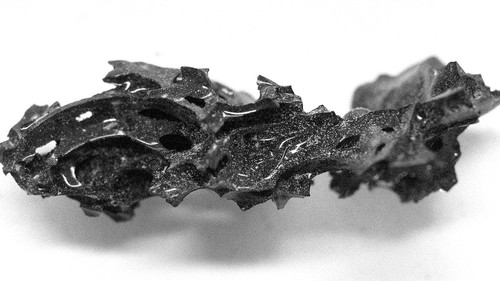
The oddly beautiful bit of brain matter. (Source: Peir Paolo Petrone, University of Naples Federico II).
Failing Upward
Where we recognise and celebrate the true stupidity of the rich, powerful and influential…
- In the years since guiding the ill-fated Prime Ministership of Tony Abbott into collapse and generally setting the country on its present austerity-racked course, Peta Credlin has had a good run. Between picking up a role commentating for Sky News and haranguing Dan Andrews, those of us isolating here in the Raising Hell bunker were interested to learn Credlin had been given a splashy new position on the board of a new conservative research institute at the University of Melbourne.The institution — which has pitched itself without irony as an “independent think tank associated with the Liberal Party of Australia” — has been funded with $7 million from the Morrison government and another $7.5 million from the Robert Menzies institute and boasts other luminaries from the libertarian right. Of course, the development has not gone without opposition from the student body and academics who worry it shows that their institution can be bought by the highest bidder — but then we fully expect their protests will go ignored on the basis that they’re just a bunch of ill-tempered lefties.
Good Reads, Good Times
To share the love, here are some of the best or more interesting reads from the last fortnight…
The source for the quote in the subject line of this edition was taken from a memo sent by the American Petroleum Institute in 1998 laying out a “roadmap” for spreading disinformation about climate change. You can find it at page 10 of this document.
A while back I got interested in the sociological concept of “elite panic”. In the last fortnight, Tanner Greer, published an essay in The Palladium expanding on the idea in a way that will catch the interest of many Australian’s:
“The wisdom of the Chinese sages who identified the loss of Heaven’s Mandate with natural calamity echoes this sentiment. They understood that crises sift the worthy from the base. It is natural for a leader to fear such a test. It is dangerous for him to deny that such a test is taking place. This is the temptation of disaster: to retreat from disaster management into perception management and to worry more that the people fear than about the dangers the people face.”
- As someone who tuned into Chapo during its early years, and then tuned out when it seemed to jump the shark prior to the pandemic, the podcast’s triumph was its ability to direct the anger of the disaffected, it was interesting reading this New Yorker essay by Andrew Marantz which analysed the show as a cultural artifact and its descent into despair.
- Speaking of culture, enjoy this read on how the CIA worked to re-forge American literature of the Cold War era by building the Iowa Writers Workshop into a content farm. Wild.
- Walter Marsh, subscriber and friend of Raising Hell, has this excellent longread in The Guardian on the struggle by Better Read Than Dead authors to unionise their bookshop.
- And of course, there is the Irish Times telling it like it is when it comes to Australia’s BS — and giving those of us who want a better country a glimmer of hope that we’re all not just going insane.
Before You Go (Go)…
- Are you a public sector bureaucrat whose tyrannical boss is behaving badly? Have you recently come into possession of documents showing some rich guy is trying to move their ill-gotten-gains to Curacao? Did you take a low-paying job with an evil corporation registered in Delaware that is burying toxic waste under playgrounds? If your conscience is keeping you up at night, or you’d just plain like to see some wrong-doers cast into the sea, we here at Raising Hell can suggest a course of action: leak! You can securely make contact through Signal or through encrypted message Wickr Me on my account: rorok1990. Alternatively you can send us your hard copies to: PO Box 134, Welland SA 5007
- And if you’ve come this far, consider supporting me further by picking up one of my books, leaving a review or by just telling a friend about Raising Hell!