Raising Hell: Issue 64: A Special Trajectory, A Magical Dignity
"It is important the public recognize the existence of weighty scientific views which old there is no proof that cigarette smoking is a cause of lung cancer," - John Wiley Hill, 24 December 1953

He was an old timer sitting in the back row. A tall, thin man with a big, white beard. He waited until the questions before he raised his hand to speak and when his turn came at the microphone he could not contain his frustration.
Introducing himself, he claimed to be a retired veteran of the Bureau of Meteorology. After a short preamble, he finally came around to his point: “I want you to prove to me, with peer-reviewed articles, how carbon dioxide is responsible for causing global warming?”
It was a classic climate denier gotcha question — one more amusing than shocking. The idea the international consensus on climate change would be unpicked from Unley Town Hall on a Wednesday night was a romantic. No one in the room on the night gave him much time — and rightly so. There was no point in addressing the content of the question and to take him seriously would be to let this man, and others like him, to set the terms of the exchange. What the moment did offer, however, is a good hook for me to dive into a broad-brush history of climate change denial.
Those familiar with the subject will already know the loose outline of the history: the mechanisms behind climate change were first described in 1896. Then in 1959 Nobel Prize winning physicist Edward Teller told a room full of oil executives that climate change was coming and carbon dioxide was the cause. Later on, in 1981, Exxon Mobil did some research and confirmed that, yeah, this climate change thing absolutely checks out before they proceeded to hide it from the public for the next three decades.
ExxonMobil did this by pumping nonsense into the bloodstream of the body-politic. These companies and their industry associations established a network of think tanks, research institutes and astroturfed community group to hum and haw about the science of climate change, but by far their best tool was public relations and among them the figure of John Wiley Hill.
Hill was a journalist who went to the darkside when he established his own PR firm which landed the tobacco industry as a client. One of this first jobs with Big Tobacco was to write its plan to stop public sentiment from turning against the industry. Over time it would become clear the industry had a body count on it higher than Hitler and Stalin combined. but Hill’s job was to help extend its life as long as possible by leaning into doubts about the science and carefully managing the media. We know this because Hill laid it all out a blueprint for the industry in briefing dated 24 December 1953. In it, he advised the industry to underline doubts about the scientific connection between smoking and lung cancer, even as it made a public effort to show it was concerned about the health of its customers, writing:
It is important that the industry do nothing to appear in the light of being callous to considerations of health or of belittling medical research which goes against cigarettes.
The tobacco indutry took Hill up on his proposal and in doing so forged a path oil, gas and coal companies would later follow when confronted with the tetchy subject of climate change. We know this because Hill’s public relations firm — which would become Hill & Knowlton, the same firm contracted to handle publicity for the COP27 meeting in Cairo — were also hired by the oil industry. As the two industries were friendly — cigarettes were the biggest selling consumer product in petrol stations — Big Tobacco opened the door for Hill to land Big Oil as clients. These close networks meant that as the sun began to set on the tobacco industry, the oil industry stepped in to assist. Oil company’s offered up their labs to test cigarettes for toxicity and even invented the cigarette filter to create the perception that filtered cigarettes were healthier for smokers.
This was a total lie and in doing so the industry created one of the most ubiquitous symbols of pollution today. Yet Hill’s tactic of exploiting doubts in the science would become the weapon of choice for the oil and gas industry as they nurtured a culture of distrust, cynicism and apathy to protect their bottom line.
Where in the US this was largely carried out by big corporate entities — the oil majors and their industry association, the American Petroleum Institute — here in Australia the story played out a little different. I’m not currently aware of anyone who has taken a dive into industry archives to document evolving attitudes to climate change but in the policy arena business tended to be handled a little differently down under. Though there were organisations like the Institute of Public Affairs which has scoffed at the idea climate change for some time, they didn’t have the same reach as their counterparts like the CATO Institute in the US. For the most part, the asault on the science of climate change was left to the nation’s oligarchs — a small group of very rich, elderly men with business interests in fossil fuels or their supply chains. Among the earlier cliques was the Lavoisier Group that included figures like Hugh Morgan, Ray Evans, Peter Walsh, Ian Webber and Harold Clough. Together these retired industrialists acted as an informal steering committee, a group which would meet to discuss the issues, get their position straight and then allow their chosen talking points to filter down through their individual networks.
Revisiting the Lavoisier Group website today is like looking through the greatest hits of climate denial. A pamphlet by Ray Evans, for example, is titled: “Thank god for carbon dioxide”. Its contents are more or less what you would expect and though this sort of climate denial has long since fallen out of fashion in favour of a more nuanced approach, this stuff does still circulate. In 2016, Liberal party donor Roger Massy-Greene accidentally sent an email to everyone in his address book with an attached 16-page document titled, "The Skeptics Handbook”. At the time Massy-Greene was chairman of Endeavour Energy and Ausgrid, two New South Wales state government owned electricity companies and the director of a coal company.
If the incident called into question the scientific literacy of a guy who struggled grappling with an email address field, the first question posed in the handbook — and the one it suggests climate sceptics asked — is as predictable as it is revealing:
“What evidence is there that more CO2 forces temperatures further?”
As the global consensus on climate change has formed, the focus today has shifted onto equivocating about potential solutions — the idea that gas is a bridging fuel or nuclear energy is the only solution to climate change. Whatever the specific line, the aim of the game is to ensure that nothing gets done — a time-worn tactic for sabotage. Take, for instance, this declassified field manual for German workers produced by the OSS (a precursor to the CIA) in World War II and its advice for how people might go about sabotaging the productivity of the companies they worked for:
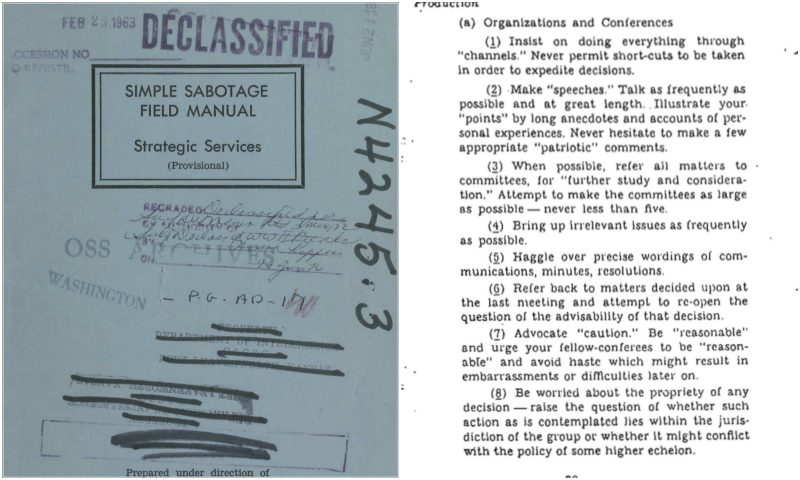
Sound familiar?
To anyone who has ever had to run a meeting in some official capacity, none of this will be a revelation but it serves as a good reminder of the difference between those acting in good faith and those looking to gum up the works — all of which brings us back to the man in the back row the other night.
It was a relative annoyance in a fun evening, but afterwards, when it was all over, I couldn’t help but feel sorry for the guy. A guy who seemed to think he was storming the Gates of Mordor was really just spitting off an overpass. Whether he realised it or not, a century’s worth of history — decades of decisions made by people far richer, far more powerful and much further away — had brought him there, to be in that room, in that moment and asking those questions. And for what? If anything, his presence was a walking, talking illustration of the ideas that we have been kept hostage to for the last two decades.
And on that note, I want to say a huge thank you to everyone who came out to Unley Town Hall last Wednesday. It was a great time and I’m grateful to have a moment to unpack all the ideas I have been chewing on over the last year. Now that I have witnesses, I have to get on and actually write that book…
For the Fortnight: November 9 to November 22
Reporting In
Where I recap what I’ve been doing this last fortnight so you know I’m not just using your money to stimulate the local economy …
- ‘‘What’s new in the latest Covid wave?” (The Saturday Paper, 19 November 2022).
- ‘‘‘I don’t use lights’: how five Australians are managing in the cost-of-living crisis” (Guardian AU, 14 November 2022).
- “World’s biggest carmakers to build 400m more vehicles than 1.5C climate target will allow” (Guardian AU, 10 November 2022).
- “How Australia became the world's greatest lithium supplier” (BBC Future Planet, 11 November 2022).
You Hate To See It
A dyspeptic, snark-ridden and highly ironic round-up of the news from our shared hellscape…
This Just Feels Right
It’s been the top story for the last two weeks: the world’s richest man, Elon Musk, sinks $44bn to buy Twitter with the express mission of snuffing out the platform inhabited by those who once mocked the “Technoking” of Tesla. His mission? To make a “radically free speech” platform or, in other words, a free-for-all for neo-Nazi’s and those freaks weirdly obsessed with transgender people. How’s it going? Not well. Two thirds of the company’s employers have quit following an ultimatum from Musk to do or die. Employees, he said in an email had to “will need to be extremely hardcore" or they could, to paraphrase, fuck off. If Musk imagined himself heroically marshalling his nerd army around him, not unlike Tom Cruise in the problematic film The Last Samurai, to make a final push directly into the path of machine gun fire, most people read the room and said fuck that. The result? Chaos. People were left trapped in breakrooms when those who controlled access walked off the job and within hours of whoever was in charge of preventing copyright violations disappearing, hours users were posting full movies to the platform, including the 1995 cult classic, Hackers — which seems appropriate.
😃
But Twitter’s misfortune wasn’t the only tech industry news making headlines — so is the bankruptcy application of cryptocurrency exchange FTX. Don’t know what FTX is? Don’t worry! Neither did its founder, Sam Bankman-Fried who’s status as a cryptocurrency king earned him a chance to hang with Bill Clinton in the Bahamas and kickstart the “effective altruism” movement whereby rich guys donate millions in philanthropic funding to scientific research and public interest media outfits like ProPublica. As it turns out, however, nearly every public statement Bankman-Fried (abbreviated to SBF) has made in public has been a lie. FTX claimed $1.36b in assets but as the company’s bankruptcy filings make clear, it had no corporate governance, weren’t really big on records, did not keep a list of all its employees, and paid workers in an online chat with custom emojis. 🙃🙃🙃 The company’s liquidator, John Jay Rai III, who handled Enron’s bankruptcy proceedings, summed up the situation thus: "Never in my career have I seen such a complete failure of corporate controls and such a complete absence of trustworthy financial information as occurred here." How has SBF responded to this? Well, he’s going down posting.
Off The Chain
Speaking of Bitcoin, the promise of blockchain was that it would change the world and in doing so it inspired a cult-like following. An enigmatic and convoluted problem that really was only eve good for safely buying drugs has never really found its niche but the bitcoin it enables is a growing source of carbon pollution. Now German manufacturing giant Siemens has partnered with the Abu Dhabi National Oil Company (ADNOC) to produce blockchain-certified low carbon Murban crude oil to help solve climate change.
Seems Like A Nice Fella
“This area doesn’t care about climate change,” declared Timothy Dragan, Victorian state Liberal candidate for Narre Warren North. The chair of the local Liberal Party branch is among the hopefuls at the upcoming state election but one who might find his chances sullied. Leaked audio, obtained by reporters at The Age, records Dragan pontificating on all matters. For instance, he declares European colonists “won this land fair and square” to explain why there are no “traditional Australians”, describes abortion as murder and suggested the country embrace nuclear energy but dump the waste in Alice Springs. Dragan, a self-described “Burkian Conservative”, ducked questions when approached by reporters but in the leaked audio appeared quite happy to expound on what he believed to be the flawed moral arguments made by those who defend the legal right to abortion in Australia, with this sterling pearl of reasoning from a man who appears not to have interacted with a vagina for a considerable time:
Why is the passage through the vagina the reason why you can or can’t murder a human? What makes a vagina’s trajectory so special? Does it give it a magical dignity or something like that, you know?”
A Different Engel
But look, on a long enough timeline, the world will find a way to make you a fool eventually. For example, did you know the mascot of the German Basketball team, the Chemnitz 99ers, is noted critic of capitalist accumulation Karl Marx?

Failing Upward
Where we recognise and celebrate the true stupidity of the rich, powerful and influential…
- We here at Raising Hell’s elite satire unit understand there are a few ways people go about getting jobs. There’s all the normal processes of applying and working through the normal process. Of course, doing it that way involves a whole lot of risk and kowtowing to authority for everyone involved. This is why some people resort to alternative measures. Leo Hardiman didn’t do anything untowards to get his job — he’s not even the real hero of this story. Rather that is former attorney-general Michaelia Cash. It seems that when the Coalition government found itself in need of a Freedom of Information Commissioner — a position they left vacant for seven years — they spent a million dollars to put together a hiring panel. This panel worked through 20 applications for the position before it made its recommendation on a preferred candidate — one which Cash duly ignored when she promoted Hardiman, an experienced government solicitor, to his position — because that’s how you get things done.
Good Reads, Good Times
To share the love, here are some of the best or more interesting reads from the last fortnight…
- Newly minister South Australian senator Barbara Pocock is writes in InsideStory about what she has learned in parliament.
- Rachel Rutledge and Ken Armstrong have this story in ProPublica about a landlord, a tenant, a housefire and the class divide in Milwaukee.
Before You Go (Go)…
- Are you a public sector bureaucrat whose tyrannical boss is behaving badly? Have you recently come into possession of documents showing some rich guy is trying to move their ill-gotten-gains to Curacao? Did you take a low-paying job with an evil corporation registered in Delaware that is burying toxic waste under playgrounds? If your conscience is keeping you up at night, or you’d just plain like to see some wrong-doers cast into the sea, we here at Raising Hell can suggest a course of action: leak! You can securely make contact through Signal — contact me first for how. Alternatively you can send us your hard copies to: PO Box 134, Welland SA 5007
- And if you’ve come this far, consider supporting me further by picking up one of my books, leaving a review or by just telling a friend about Raising Hell!