Raising Hell: Issue 79: The New Insincerity
"Men are convinced of your arguments, your sincerity, and the seriousness of your efforts only by your death," - Albert Camus, French journalist and author in "The Fall", 1957
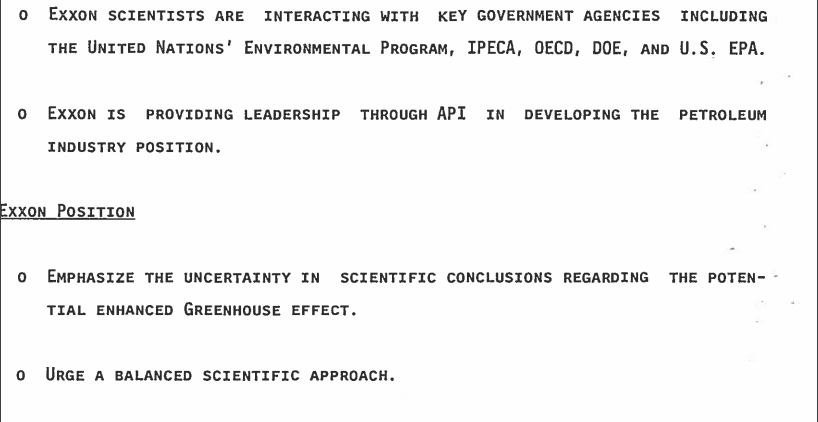
It was the image of Peter Dutton waxing poetical about the fate of whales that really did it for me. If you recall, rallies had been taking place in communities along the New South Wales coast, allegedly to raise concerns about proposed new offshore windfarms. The news was aflutter in this stories as critics variously argued that the development would “ruin the visual amenity”, murder birds or disrupt the migratory path of whales.
It is also worth recalling that Dutton is a man who, on the even of a leadership challenge, once had to remind the Australian public he does, in fact, possess a sense of humour. So it was a jarring shift in two when the man came to Nelson Bay to rail against.
“There’s no environmental consideration of what these huge wind turbines, 260 – 280 meters out of the water, will mean for that wildlife and for the environment,” he managed to say with a straight face.
I’m sure Dutton, an ex-Queensland cop has never seriously turned his mind to the health and safety of the ocean’s whale population, except in the rare instance where he may have considered jailing an anti-whaling activist as part of his duties. Jokes aside, I’m late to the party and much has been already written about the credibility of the claims being made by the anti-wind crowd and the Coalition’s opportunistic embrace of these “concerns” to make it seem like they’re listening to the grass roots. Most notably, the party spent ten years in power approving every massive, climate-killing coal mine that came across its desk.
It was a small, obvious gesture which would have surprised no one among Australia’s commentariat — politicians gonna politician and all that. But even this transparently hollow and reflexively contrarian moment speaks to something deeper — a total refusal among a certain segment of Australian society to believe that other people are capable of holding a sincere position about anything at all.
Words, ideas, issues, concerns — all these things have no meaning to people at a certain echelon of Australian decision makers. These are people who are so morbidly cynical, such self-important game players, that when they encounter someone out in the wild who actually believes that we should do things about issues like climate change, or stopping Gaza being reduced to ruins, it is impossible for them to compute.
The clearest expression of this problem only came recently when journalist Faine Greenwood responded to news of protest camps at Columbia and UCLA being cleared by force. Posting to BlueSky, they wrote:
We are faced with an absolute plague of powerful people who REFUSE to believe that anyone ELSE is sincere about their beliefs, from student protesters against genocide in Gaza, to right wing fanatics baying for the blood of minorities.
If one thing unites the modern pundit, political, and mega-executive classes today, it’s that they’ve convinced themselves they’re *so* smart and world-weary that they *refuse to believe* the obvious reality that people are usually sincere about the stuff they say they’re sincere about.
In fairness, attributing this poisonous attitude to “cynicism” is probably unfair to cynics. A healthy degree of cynicism is required to scrutinise those in power and to hold them account. More precisely, I’d suggest this is a form of political nihilism; the idea that nothing matters except that which gets the person making the statement another step closer to power.
This framing helps makes a sense of our current political moment, as well as those in the past. Take the whales; this explains, for instance, why right-wing political leaders are so hostile to those campaigning on environmental or climate issues. Sure, there are material benefits to backing in industries with significant fundraising capacity, but at a certain point it is simply impossible for these decision makers to believe that those calling for action are genuine.
These are people so acutely aware of their own willingness to do and say anything in the pursuit of power, it doesn’t compute that people climate and environmental activists might genuinely care about the issues they are fighting over. To the political nihilist, so used to engaged in bad faith, anyone sincere about their position is either naïve and stupid, or actually tied up in some elaborate conspiracy that threatens their own status. This leads to all sorts of bizarre conclusions — versions of which I have encountered in the wild over the years. The climate activist wants to be brutalised by police to make a political point; the journalist asking questions must have an agenda; the scientist criticising the company only wants more grant funding.
This does not just apply to the world of political decision makers, but across the board among business leaders, media figures and the bureaucracy. Take, for example, a recent twist in Munkara, an ongoing Federal Court case involving the Environment Defenders Office and oil giant Santos. The procedural specifics are irrelevant to the current point — what matters is that I sat through a recent court listening to lawyers for Santos arguing about whether the company should be allowed to subpoena four organisations who were not directly involved in the initial lawsuit. Over the course of that hearing, Santos suggested a grand conspiracy on the part of these third party environmental groups; it never seemed to occur that people who care about issues like Indigenous land rights, environment and climate might work for next-to-nothing or free.
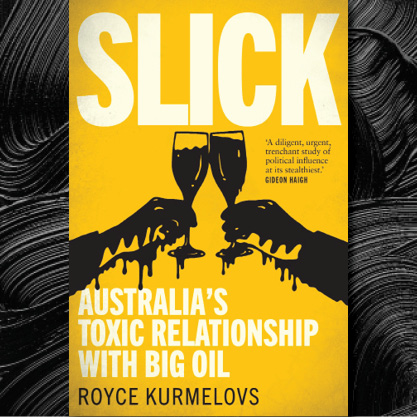
This was also an attitude I regularly encountered in writing Slick. Over the 18-months I spent researching the book, I attended oil and gas conferences as a registered member of the media. It will shock no one that the only goal of the executives was money, but what was surprising was the extent to which they assumed “their opponents” were just as cynical as them. There were times when these executives spoke with envy — almost bordering on respect — about the communications strategy of groups like Extinction Rebellion. These conversations almost always devolved into statements about the need for industry to better present itself to the public as being essential to the transition. To me, listening in the audience, it seemed as if these executives thought of the public discussion over climate change — a physical reality where the composition of the atmosphere was being changed by the continued burning of fossil fuels — as little more than competing sales campaigns. Industry had its marketing plan, the climate activists had their own. and the future would be decided by whoever had the better advertising.
Of course, those considered “elites” have always behaved this way in some form. What makes things different now is the depth, volume and magnitude of the New Insincerity — and the stakes. In this view, nothing is real, tangible, material or meaningful. Everything is negotiable. The first lie wins. The numbers don’t lie, but they sure do bend if you cut the statistics right. There are a no good faith actors, just bastards all the way down — better to kick arse than get your arse kicked.
But then, as Greenwood so neatly articulated, the reality is that these decision makers, the people who consider themselves savvy, 4D chess players who know all the angles, are so smart they’re stupid. And in this moment, such stupidity will get people killed.
For the period of 24 April to 7 May…
Reporting In
Where I recap what I’ve been doing this last fortnight so you know I’m not just using your money to stimulate the local economy …
- ‘Activist groups not directly involved in Tiwi Island lawsuit must hand over documents to Santos, court rules’ (Guardian AU, 25 April 2024).
- ‘Two 17-year-old climate activists claim WA premier Roger Cook defamed them over Woodside Protest’ (Guardian AU, 2 May 2024).
- I’ve also been in a long-running Freedom of Information battle with CSIRO over access to documents. The agency has appointed senior counsel within it’s legal time to respond to my requests and has largely been rejecting them on, often on spurious bases. I can’t say more as it is part of a wider project, but I look forward to talking about it when it comes together.
- I was interviewed on community radio station Bay FM’s environment program about my upcoming book.
Before You Go (Go)…
- Are you a public sector bureaucrat whose tyrannical boss is behaving badly? Have you recently come into possession of documents showing some rich guy is trying to move their ill-gotten-gains to Curacao? Did you take a low-paying job with an evil corporation registered in Delaware that is burying toxic waste under playgrounds? If your conscience is keeping you up at night, or you’d just plain like to see some wrong-doers cast into the sea, we here at Raising Hell can suggest a course of action: leak! You can securely make contact through Signal — contact me first for how. Alternatively you can send us your hard copies to: PO Box 134, Welland SA 5007
- And if you’ve come this far, consider supporting me further by picking up one of my books, leaving a review or by just telling a friend about Raising Hell!