Issue 96: Social Cohesion™
"the average is the only thing that matters" - Jeffrey Epstein in email discussion with Joscha Bach about society, fascism and ant colonies, 24 July 2016 at 12:20am.
Back in the early days of BlueSky, at the beginning of the right-wing takeover of the media ecosystem, I did a post. Or rather, a series of them. Was it cringe? Maybe. But as usual, I was bored and annoyed, and one thing led to another.
I was reminded of this particular thread ahead of Israeli President Isaac Herzog's, a man accused of inciting genocide in Gaza, arrival in Sydney on Monday. By inviting a political leader over a senior religious figure, the Prime Minister had invited a shitshow by further politicising the most politicised terrorist attack in Australian history. The key words leading up to the visit, however, were "social cohesion". From Albanese's lips to the arrival of Herzog, the Adelaide Writer's Week fiasco, Queensland's plan to make it illegal to say "from the river to the sea" within its state boundaries, and the videos of cops in full battle-rattle, tear-gassing anti-war protests on Sydney streets, a flurry of action was being taken to "preserve social cohesion".
Guardian Australia reporter Jordyn Beazley filmed this video not long ago of police moving towards protesters down Elizabeth Street in the Sydney CBD following the rally at Town Hall.
— Shelley Hepworth (@shelleymiranda.bsky.social) 2026-02-09T09:50:14.990Z
The phrase of the moment has irritated me ever since I first encountered it in a Year 11 legal studies textbook. It has always felt vague, ambiguous and meaningless—especially so in any discussion about the mechanics of the Australian legal system which, as a teenager, I thought was supposed to be among the most serious discussions you could have. An amorphous phrase, it is one that gestured at the need to "get along" but really offered nothing tangible. It said nothing. It described nothing. At best it might be said to describe some sense of "unity" or perhaps "order"—but if that's the case, why not just be clear and use those words? Even then, I felt it was the rhetorical equivalent of your tired, exasperated Gen X parents telling you to be nice to your brother. Sure, he may have hit you first, but who is counting?
More recently, "social cohesion" has come to be spoken about as if it were an entity in itself, in the same way people talk about "the economy". Apparently, it has feelings. Things can "hurt" social cohesion, or "harm" social cohesion. Social cohesion is something that needs to be "protected". We can even allegedly measure this hurt, as the Scanlon Foundation has since 2007. That, however, is a contemporary development. Whitlam may have used the phrase in his "It's Time speech", but as I found when I went back and looked, the words "social cohesion" and their associated meaning took shape in the 80s with a stew of right wing political commentators talking about civil rights and migration. By adopting this phrasing as a badge for its broader work on internal strife and discord, the Scanlon Foundation appears to have helped them into the mainstream.
This is interesting -- from 1983, this is the first instance I've seen where "social cohesion" is tied to broader assimilationist ideas. I don't know anything about the author or the context, but the author appears to compare Indigenous demands for self-determination to, well, the Nazis.
— Royce Kurmelovs (@roycerk2.bsky.social) 2024-10-14T05:22:48.541Z
For background, the charitable organisation was created by billionaire Peter Scanlon in 2001—notably in the wake of the September 11 terrorist attacks. To his credit, Scanlon, whose net worth was estimated by the Australian Financial Review in 2025 to be around $1.2bn, has always seemed to care about the wellbeing of migrants. Over time, however, the organisation's research and advocacy work has become something of a pro-business anti-racism framework that lops off the messy, confrontational bits that might be associated with civil rights movements or "critical theories" to offer up something more palatable.
Naturally, this approach has been embraced by the nominally centre-left Labor Party as it has sought a political strategy to neutralise the political right's use of anti-refugee and anti-migrant rhetoric as an organising strategy. It should hardly surprise that Labor insiders have reported that the Prime Minister possesses a "visceral" fear the right will exploit intra-communal tensions for political advantage. By one count of published speeches, Anthony Albanese has used the phrase "social cohesion" more than 75 times since March 2023. Neither is it shocking that the Coalition and various right-wing commentators have sought to turn the language of "social cohesion" on anti-war and anti-genocide protesters in the wake of the Bondi shootings. Australians generally seem pretty unified in their shared horror at both the Bondi massacre and Israel's total destruction of Gaza, but it's funny how we keep hearing that the country remains bitterly divided.
The final fact in ensuring "social cohesion" went mainstream appears to be Australian law enforcement which embraced the thought as part of its broader work building Countering Violent Extremism programs. For the better part of a decade, of course, these programs have been aimed not at Australia's white nationalists, but at people considered likely to engage in Islamic terrorism. When I looked, I found an inflection point in 2017, when Australian Federal Police Commissioner Andrew Colvin gave a talk on the subject. He defined "social cohesion" as "the willingness of members of our society with each other in order to survive and prosper". Quoting the quoting Lord Harman Ouseley, Chair of the UK Commission for Racial Equality, Colvin said social cohesion required:
"Social cohesion must encompass the basic principles of justice, fair treatment, equality of opportunity, equal participation and self-determination from all people of diverse backgrounds in these societies if we’re not to have social chaos, breakdown and even disorder.”
Of course, it would be hard to find anyone who would disagree that these are important objectives every society should pursue—the catch is getting them to follow through. It is the second part of this statement, however, that is the tell. By implication, and read in context, it lets slip the basic assumption that without constant watch by more responsible, sensible—dare we say 'civilised'—figures in society, all those migrants, with their confusing and impenetrable ancient hatreds, will be out killing each other in the street by dawn. Perhaps that was why no one was paying attention when a 28-year-old Australian white nationalist checked in for a flight to New Zealand to go shoot up two mosques in 2019.
Extraordinary footage. Police pulling off people engaged in peaceful prayer.
— Fahad Ali (@fahad-s-ali.bsky.social) 2026-02-09T10:03:37.053Z
It should be no wonder then that Australians bristle against this language. Whatever the intention, in practice, "social cohesion" functions as a polite euphemism for white Australian anxiety about race relations and a clumsy tool for social control. When actually applied outside the lab it gets mixed up with the application of power. The emphasis, predictably, is on tone above content, with the goal of avoiding conflict before it takes place. Sometimes this is a good thing, but when groups have real, tangible grievances involving fundamental questions of justice that are not meaningfully addressed or acknowledged, all those good intentions quickly breakdown into smarmy condescension. Whether it's migration, refugees, Indigenous rights or climate change, the message is the same. Just like tired, disinterested Gen X parents telling you to be nice to your sister, the authorities don't particularly care about how the fight came about or what is right, all they are asking for is five minutes peace. Unlike children, however, adults will generally go do something about it—like protest.
Good Reads
Because we here at Raising Hell know how much you love homework…
- Elizabeth Lopatto, writing in The Vine, discusses the revelations in the latest Epstein documents and identifies how the paedophile and billionaire was behind a reactionary push against #MeToo that insisted rich man should not face consequences for their actions. Lopatto also connects this with the current political moment in the US that treats laws as for poor people.
- The title of this newsletter was taken from another blistering meditation on the politics of social cohesion by Ronni Salt over at The Shot. Give it a read.
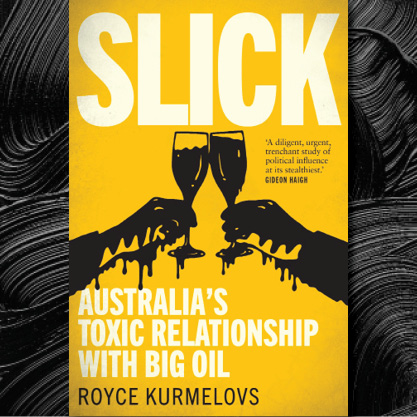
"Many books about climate change are worthy but dull. Slick, however, is as readable as it is shocking." - Richard Denniss, The Australia Institute, writing in The Conversation.
Reporting In
Where I recap what I’ve been doing this last fortnight so you know I’m not just using your money to stimulate the local economy …
- ‘What happened the day Bjorn Lomborg met Jeffrey Epstein' (Drilled, 4 February 2026).

- I have a 4000-word feature story pending with Drilled about the new ABARE documents I pulled from the archive. At the time of writing the story is with the fact check.
- I have another 4000-word deep dive on lobbying efforts by Japanese companies aimed at locking in fossil fuel production in Australia.
- I have begun work on two new stories this fortnight, one that had been on the books for a while, and another newer one concern dark tourism and climate change.
- I was also invited to appear on a ABC Radio National's God Forbid program with James Carlton to talk about debt. It's been sometime so I was a little rusty on this issue but it was a fun chat.
Before You Go (Go)…
- Want to get in touch? Message me on Signal at username RoyceK.11. Alternatively you can send hard copies to: PO Box 134, Welland SA 5007
- And if you’ve come this far, consider supporting me further by picking up one of my books, leaving a review or by just telling a friend about Raising Hell!