Issue 98: Climate Change Is Killing The Liberal Party
"As the leader of all illegal activities in Casablanca, I am an influential and respected man." - Senator Ferrari, black market operator and people smuggler, Casablanca, 1944
Last week Australian Prime Minister Anthony Albanese tabled the Liberal Party's autopsy of its catastrophic 2025 federal election wipe-out in parliament, presumably with considerable glee. This was a document considered so explosive—with conclusions so damning former opposition leader Peter Dutton issued defamation threats—the Liberal Party leadership tried to keep it a secret. It leaked anyway. Tabling the document was a political gambit, one that occurred right as Albanese leapt to become the first world leader to endorse the US and Israel's war of aggression against Iran. Though a distraction, it was not without value. Making the document public in this way ensured it was possible to quote from it without risk of a lawsuit, giving the public a rare look into the plumbing of the Liberal Party circa 2026—and what may be yet to come.
The gist is as you would expect: the party of personal responsibility and freedom remains convinced of its righteous cause, but fears the general public thinks it is racist and sexist. Apparently, the Australian people loved Trump's return, at least first, but then soured when the tariffs started hitting. Everyone thought Dutton was too much like Trump, it concluded—even his own party members thought he was authoritarian but largely went along to get along. Of course, the crowning achievement of the Dutton-led Coalition was sabotaging the referendum for an Indigenous Voice to Parliament, which party big-wigs still considered a glorious triumph, even though this didn't translate into electoral success.
It was the stuff of comedy, but then that is perhaps to be expected. The 61-page report offered a read of the political landscape that feels very much in tune with the vibe of its authors, former South Australian senator Nick Minchin, a climate denier, and former Liberal MP Pru Goward, who infamously wrote in a column for The Australian Financial Review there was an "underclass" of Australian "proles" who were "always the last to give up smoking, get their shots and eat two servings of vegetables a day." Buried within the wider document, however, were a few other observations and insight that have received less attention, notably an acknowledgement from the party that its membership was aging out and that young people hated them, by some counts, at a ratio of four-to-one. To counteract this greying majority, the authors suggested deploying the Young Liberals—possibly the most annoying political group in the country, seconded only by Young Labor.

The devil lurking in the detail of this particular document, and the subsequent reporting, was what it said—and didn't say—about climate change. Like most Australian approaches to the issue on the political right, this was a conversation mostly handled indirectly through the Liberal Party's analysis of its continued reliance on nuclear power. As I have said elsewhere, the idea of an Atomic Australia will never die. It is a political idea that is immune to empirical evidence but endures because it remains useful to particular constituencies. There is a long and torrid history to this within conservative, nationalist and libertarian circles, but most recently the federal Coalition has found the idea useful for papering over its biggest internal dilemma: climate change.
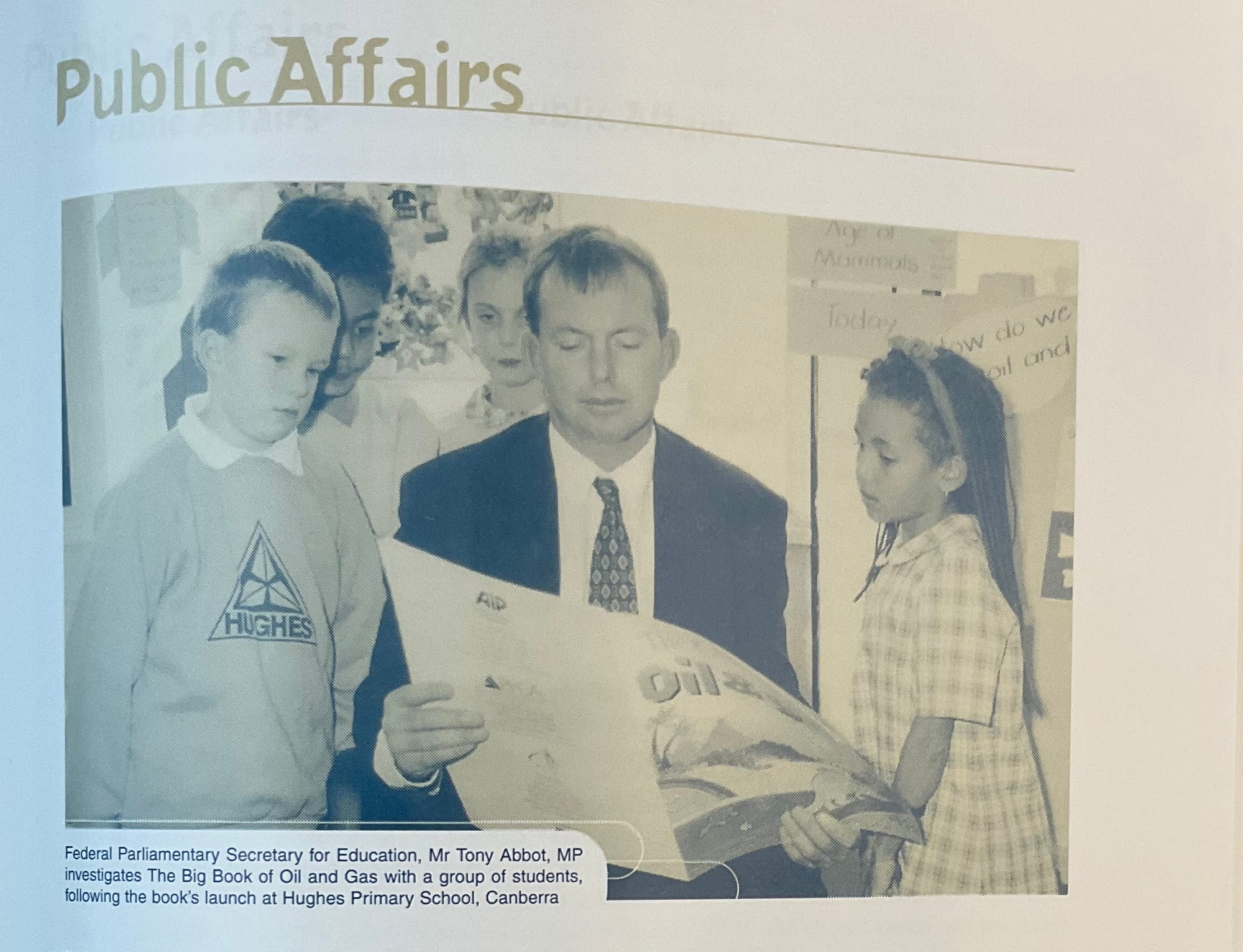
Oil and gas have been central to the Liberal Party's identity and core constituency since the stuff was first discovered in Australia in 1953. Shell executive William Hewson Anderson served as federal executive of the party between 1951-to-1956 and the government of Robert Menzies went out of its way to court the industry. Oil was at the heart of the Whitlam dismissal, when John Howard was a soon-to-be elected staffer. So it is little wonder than that climate denial, a form of protectionism for oil and gas producers, became central to the Liberal Party's worldview when Howard took over the leadership at the dawn of the new Millennium. At that time, of course, a young cabinet minister in Howard's government, Tony Abbott, had the good sense to court the industry as a fresh MP and, as Prime Minister himself, set about slashing and burning any policy that so much as suggested climate change was a problem. This was interrupted by a brief, ill-fated challenge from Malcolm Turnbull, but would later be revived under Scott Morrison who once declared that electric vehicles would "end the weekend", and orchestrated a "gas-fired recovery" from the pandemic.
Under Dutton's leadership, the party appeared to dream of a blue-blue alliance between conservative political groups and blue-collar workers—an idea imported from Canada as I reported out in this extremely long read for Drilled, an article that was meant to be my final word on the subject. This was to be galvanised by the creation of a bright-green nuclear industry that offered steady, secure union jobs. Taking inspiration from Ontario, Dutton appeared to imagine the nation's tradies as a crop of vaguely malevolent Homer Simpsons who might carry him to victory against the weak, tearful, inner-city wokes.
This is all critical context for how the absurd collision with reality the Liberal Party experienced at the last election. On the one hand, it found that women in particular thought the macho, nuke-bro stuff was "weird". On the other, it reported that the Liberal Party Federal Secretariat had previously looked into it, commissioning research "on the politics of nuclear power and the extended time it would take to convince Australians that nuclear power was acceptable". It found that to "persuade Australians that nuclear power was acceptable" would take a "staged campaign" run over "several years."
"The research confirmed that a long campaign would be needed to change the minds of the majority of Australian voters, especially female voters, who were concerned about nuclear safety and viewed nuclear power sceptically or negatively," the report said. "Such a campaign would take considerable effort."
Dutton and his office, of course, didn't want to hear it, but the key takeaway is not the conclusions the report draws about the past, but what it hints about the future. At no time does it suggest abandoning the policy. Rather, the authors go on to note that "there was also strong and active support in some business and commercial circles for a nuclear power program" that could have been "converted to strong third-party campaigning", adding that "any opposition leader who commits to an ambitious, courageous policy such as nuclear power, must ensure that third party support is well informed about the challenges ahead and prepared for a long journey." These comments, however, should be read alongside others in the report about the need for more "keyboard warriors" to support Liberal candidates or "[mock] and attack their opponents in retaliation".
These conclusions are perhaps a little uncharitable to third-party groups like Advance, Australians For Natural Gas, and the wider constellation of pro-nuclear activists, who really did do their best to promote the federal Coalition's pet policy. But then more absurd is another key omission throughout the document: climate change. These two words appear once in the entire document, when quoting former Howard-era cabinet minister David Kemp. Even there, they are used to convey climate denial and an contempt for the concerns of young people who are presented as being mislead by "alarmists". As Kemp told the review:
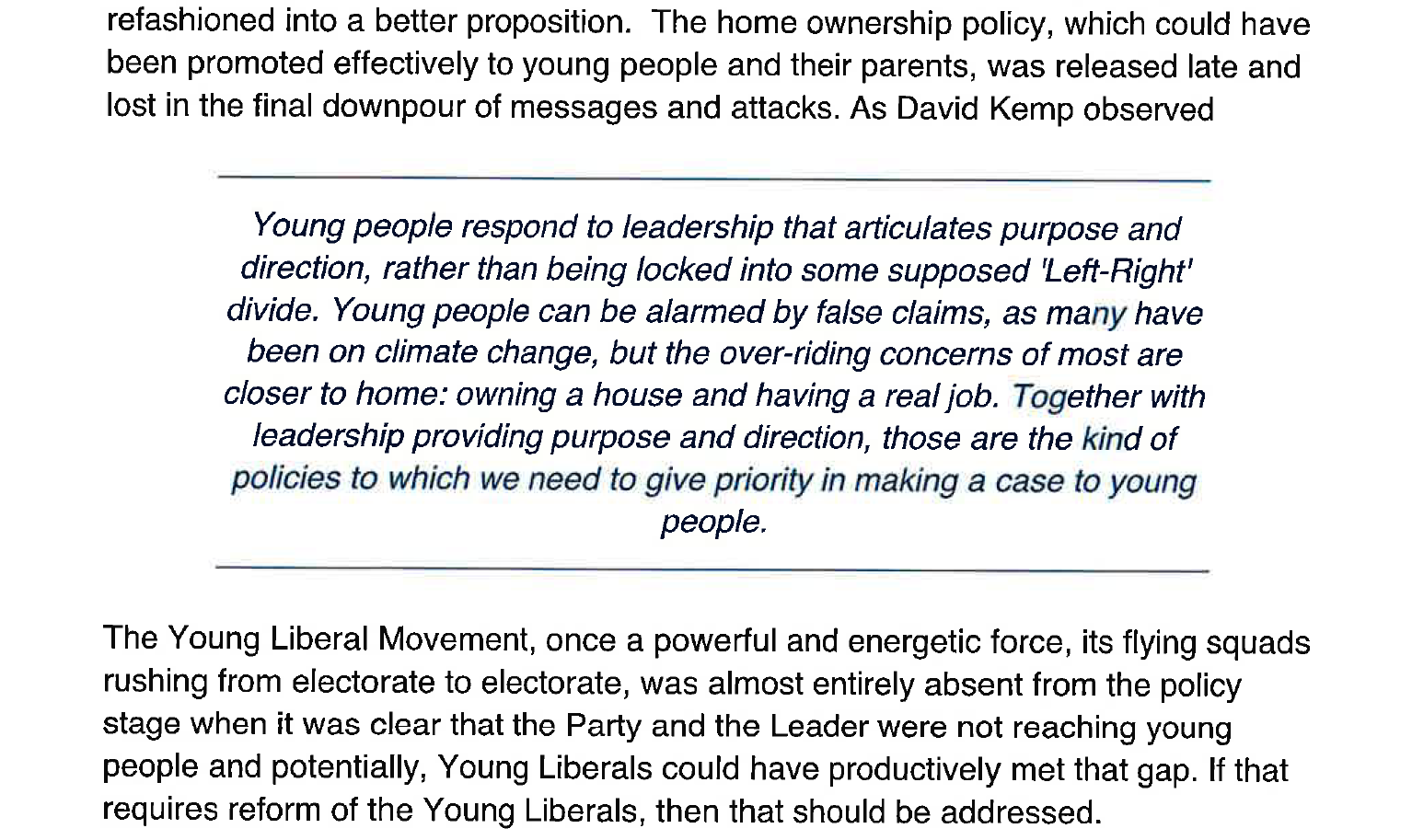
It's difficult to get grandpa to understand something when his retirement depends on his not understanding it, but the total refusal to even discuss climate change beyond denunciations and condescension remains a blind spot in the party's broader engagement with reality. Even where it acknowledges that Scott Morrison's handling of the Black Summer bushfires, a notable climate impact, contributed to his political defeat it still failed to link this with broader community concerns. This is expressed most clearly where it discusses the political challenge posed by the Teal Independents. The Liberal Party clearly hates and fears the Teals in equal measure, but what is remarkable is how it fails to understand its enemy. Not only does it refer to the grouping as a "party", which suggests centralised coordination, but it recommends Teal candidates be "confronted head-on". The Teal Independents are not a "party" in any conventional sense, but a political insurgency operating behind the lines in occupied Liberal Party electorates. In an alternative reality, many of these candidates would have likely found themselves a political home in the notionally centre-right party. What motivates this insurgency? Climate change. Start to take the issue seriously, you start to undermine their movement.
What this all indicates is a crisis of elite renewal within the Liberal Party, where it struggles to admit and hold new members among the core group of decision makers and donors. A dwindling, aging membership means the party's direction is driven by the same personalities, embracing increasingly narrow and out-of-touch thinking about the world around them. This internal bloc is now forcing the party to double down on all the most toxic behaviours that have made its brand electoral poison. As the review suggests, at the next election, we can expect it to deploy an army of internet trolls and online chuds to club opponents in a broader information war. It will do more astroturfing and launder smear campaigns through third party groups, including right-wing activist groups and business lobbies. And if successful, it clearly intends to take a chainsaw to any Australian climate policy that does anything that even close to helping slick the country's thirst for fossil fuel.
Good Reads
Because we here at Raising Hell know how much you love homework…
- I've always liked Albert Camus. Matthew Sharpe writing in The Conversation has a good summary on his ideas and his rejection of "gangster-morality" among the far right.
- The Intercept's Nick Turse spoke to four US government sources who all say the same thing: the Trump administration has no idea what will happen to Iran after the war and haven't really thought about it.
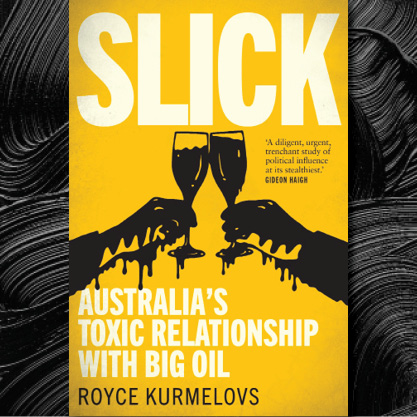
"Many books about climate change are worthy but dull. Slick, however, is as readable as it is shocking." - Richard Denniss, The Australia Institute, writing in The Conversation.
Reporting In
Where I recap what I’ve been doing this last fortnight so you know I’m not just using your money to stimulate the local economy …
- I have filed a story on ACCR v Santos, and I have been working on two others, one looking at defence thinktanks that have been advocating for gas, and another about the poison's regulator. By the time the next issue roles around, they should be out in the world.
- I also have additional documents back from the National Archives of Australia that appear to show Australian bureaucrats charged with regulating the petroleum sector mobilised from the very beginning to help pour cold water on the government's climate action. I may share some of these in the next issue. Depending how things.
Before You Go (Go)…
- Want to get in touch? Message me on Signal at username RoyceK.11. Alternatively you can send hard copies to: PO Box 134, Welland SA 5007
- And if you’ve come this far, consider supporting me further by picking up one of my books, leaving a review or by just telling a friend about Raising Hell!