Issue 99: Bombing Out On Iran
"You are the moderate man, the invaluable understrapper of the wicked man. You, the moderate man, may be used for wrong but are useless for right." - Character in dialogue from The Confidence-Man (1857) by Herman Melville.

I have a morbid fascination with the US and Israeli war of aggression against Iran, particularly after Prime Minister Anthony Albanese became the first and only world leader to give his country's support to the attacks. By now the point has been well made by others: attacking a theocratic regime that has been waiting to be attacked the better part of at least two decades, and which has, really, acted with remarkable restraint for the last couple of years, was always going to end badly. With US hegemony dependent on the global flow of free trade, and, particularly, the free flow of fossil fuels through the Strait of Hormuz, bombing Iran was a little like punching someone who already has a knife to your throat.
It goes without saying that, for all the time Iran—and to a lesser extent the US—has been preparing for this showdown, the rest of the world has had decades to ween itself of oil, gas and coal consumption. It simply hasn't. Three decades of climate negotiations offered an opportunity. It wasn't taken. The pandemic gave a sharp reminder. It went unheeded. There was a third chance when Russia invaded Ukraine. Did the world move to electrify everything? No. It did nothing—and then it has the nerve to complaint about China's rush to embrace an electrotech future as part of its broader geopolitical ambition. Having the world's supply chains concentrated in one, authoritarian state is not a good thing, to be sure, just as having the world's fossil fuel production concentrated among a bunch of authoritarian, theocratic states subject to US imperial hegemony turns out to have been a bad idea, too. But let's not forget that Europe and North America have known about the threat posed by climate change since the 60s, and the world has ostensibly sought to take the issue seriously since 1988. Little has been done—though in fairness what has been done already has had an outsized impact. Electric vehicles have substantially blunted the impact of a global oil shock. So too have renewables. Rising prices have only made the economics and logic of solar and wind more attractive. The tragedy in it all is not only that we should have done more, but we could have and simply did not.
This observation sharpened for me recently when revieing another 600-page stack of documents I recently got back from the National Archives of Australia. These documents are ancient history, dating back to 1988 when the Hawke government formed the Working Group on Greenhouse Gas Emissions to figure out what emissions reduction targets the country should embrace. At some point I would like to use some of these materials for one or more stories, so I won't get into them too much. Under the circumstances, however, I do think it's worth highlighting one thing: the extent to which the political arm of Australian industry has been playing for time since the first moment since the Australian government started to seriously think about the threat posed by climate change. In this moment, I think it is worth a reminder that Australian heavy industry—and the bureaucrats and political leaders who helped them—share responsibility for the country's continued dependence on expensive, volatile and dangerous imports of fossil fuels.
To give a little context: the documents record briefings the Department of Primary Industry and Energy (DPIE) were giving their minister ahead of cabinet meetings to decide the implementation of emissions reduction targets. DPIE, plainly, were against the idea, and were especially against any sort of interim targets being implemented while everyone argued over whether the official ones should be stood up. What is notable is the extent to which, even then, they were relying on the kind of sophisticated climate denial that is easy to spot today—not arguing about whether the threat exists, only arguing about how best to get there. The second thing to keep how government department's like DPIE function. Think of any government department as funnel into which the thoughts, feelings, facts and preferences of its constituency pour like raw crude. Out the other end flows a golden, honeyed petroleum ready to be ignited by the minister in the confidential sanctity of the cabinet room. In DPIE's cases, its constituency were those owned the country's coal mines, oil pumps, offshore gas rigs, refineries, smelters and factories.
With that understanding front of mind, have a read of this section of one briefing:
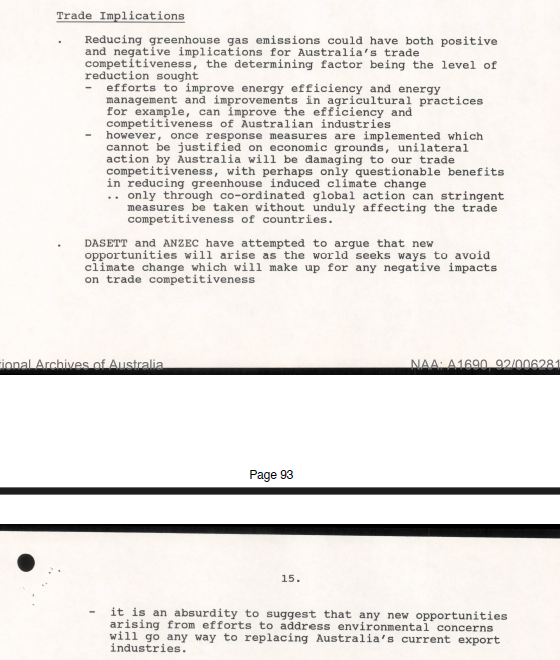
These passages are relative historical footnotes but are damning in light of recent events. The overall thrust is straightforward. The greenies at the Department of the Arts, Sport, Environment, Tourism and Territories (DASETT) were calling for the implementation of targets in line with the science but DPIE were aware they were politically isolated in cabinet. Industry was freaked out about the sudden push for climate action. Coal was king. Absolutely nothing should be done that might interfere with the status, DPIE suggested, because that threatened everyone's money. Elsewhere among the files are materials that appeared to recognise the potential for genuine harms Australia would endure as the result of climate change. DPIE knew Australians would suffer. Even if the computer technology wasn't there to drill down into specifics, there was a fair effort to game out the stark impacts on human health, cities, food production—and yes, even oil, gas and coal production—across the country. None of that mattered. Though it was never said explicitly, DPIE's message was consistently clear: faced with the choice to mitigate climate change by beginning a path to phaseout oil, gas and coal, and the alternative possibility of adapting to whatever might come, the department thought it more profitable to gamble on the second.
All of this is crystallised in a single dot-point contained in the briefing above. DPIE though DASETT's suggestion Australia might build new industry's in manufacturing for renewable energy. Oil, gas and coal made Australia's world go round. Here is the key line:
"DASETT and ANZEC have attempted to argue that new opportunities will arise as the world seeks ways to avoid climate change which will make up for any negative impacts on trade competitiveness. It is an absurdity to suggest that any new opportunities arising from efforts to address environmental concerns will go any way to replacing Australia's current export industries."
To emphasize: this was the thinking at the very dawn of Australian climate action, and a logic that would be locked in for decades. This was a moment where Australia stopped to consider the kind of future that China has embraced today, and rejected it out of hand. As I have previously reported in a feature for The Guardian in 2021, at the time, a team at the University of New South Wales had been breaking records on the efficiency of solar panels year-after-year over decades. During the 90s, these researchers attempted to set up a PV solar manufacturing plant outside Sydney but the venture collapsed. There were many reasons for this, but it didn't help the Australian government wasn't interested. When it eventually fell through, a Chinese PhD student who had come across to work with the team returned home, where he set about building his own factory to manufacture solar panels. At first, the Chinese Central Government was neither interested, nor hostile, but the rapid growth of this new industry, and the obvious geo-political logic, eventually won out. Germany's feed-in tariff helped turbocharge the growing market, and today, solar is the cheapest form of energy human has ever produced.
Australia gave it all away. Australia did it again when it killed off what was left of the car industry, a domestic manufacturing capability that could have been re-tooled to rebuild the country's road fleet as electric vehicles. History would repeat when former conservative prime minster Scott Morrison took a tour of Toyota's hydrogen showroom and declared the electric vehicle would kill the weekend.
Australian governments have consistently chosen to keep Australians awash in fossil fuels. This is something that bears repeating. Our current predicament isn't the product of random chance. Our leadership and bureaucracy chose this. Again and again. The US and Israel may be directly responsible as those who struck Iran, but our collective choices have been building up to this moment for a long time— something to keep in mind as the price of petrol spikes above $2.60 a litre.
Good Reads
Because we here at Raising Hell know how much you love homework…
- There is no better summary of the present moment than this write up at Gold and Geopolitics that captures all the glorious absurdity.
- If you came of age in the late 90s or early 2000s, you'll likely know Afroman as the soulful poet who was supposed to clean his room, but then he got high. Well, Joseph Foreman (a.k.a Afroman) emerged victorious last week in a righteous fight over a group of Ohio police officers who raided his home, flipped him off on camera, allegedly took his money and then had the temerity to sue Foreman for making a diss-track about them. The account of what transpired, including Afroman turning up to court in an American-flag suit and glasses, is a fun read—as is another diss-track he released on the eve of the defamation trial in which he claimed Officer Randy Walters "is a son of a bitch".
- In case you missed it, the Pope's AI advisor followed up his attendance at one of Peter Thiel's anti-Christ lectures in Rome with an editorial published in a French publication titled: "American Heresy: Should Peter Thiel Be Burned at the Stake?"
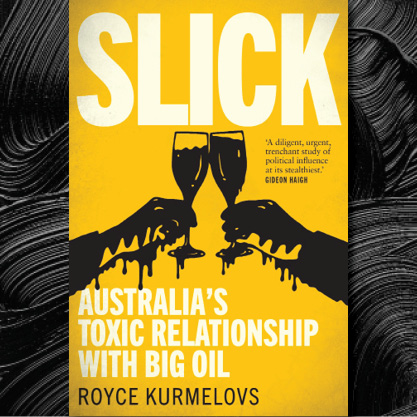
"Many books about climate change are worthy but dull. Slick, however, is as readable as it is shocking." - Richard Denniss, The Australia Institute, writing in The Conversation.
Reporting In
Where I recap what I’ve been doing this last fortnight so you know I’m not just using your money to stimulate the local economy …
- 'EPBC reforms a ‘net positive’ for oil and gas, according to Department' (The Point, 18 February 2026).
 Royce Kurmelovs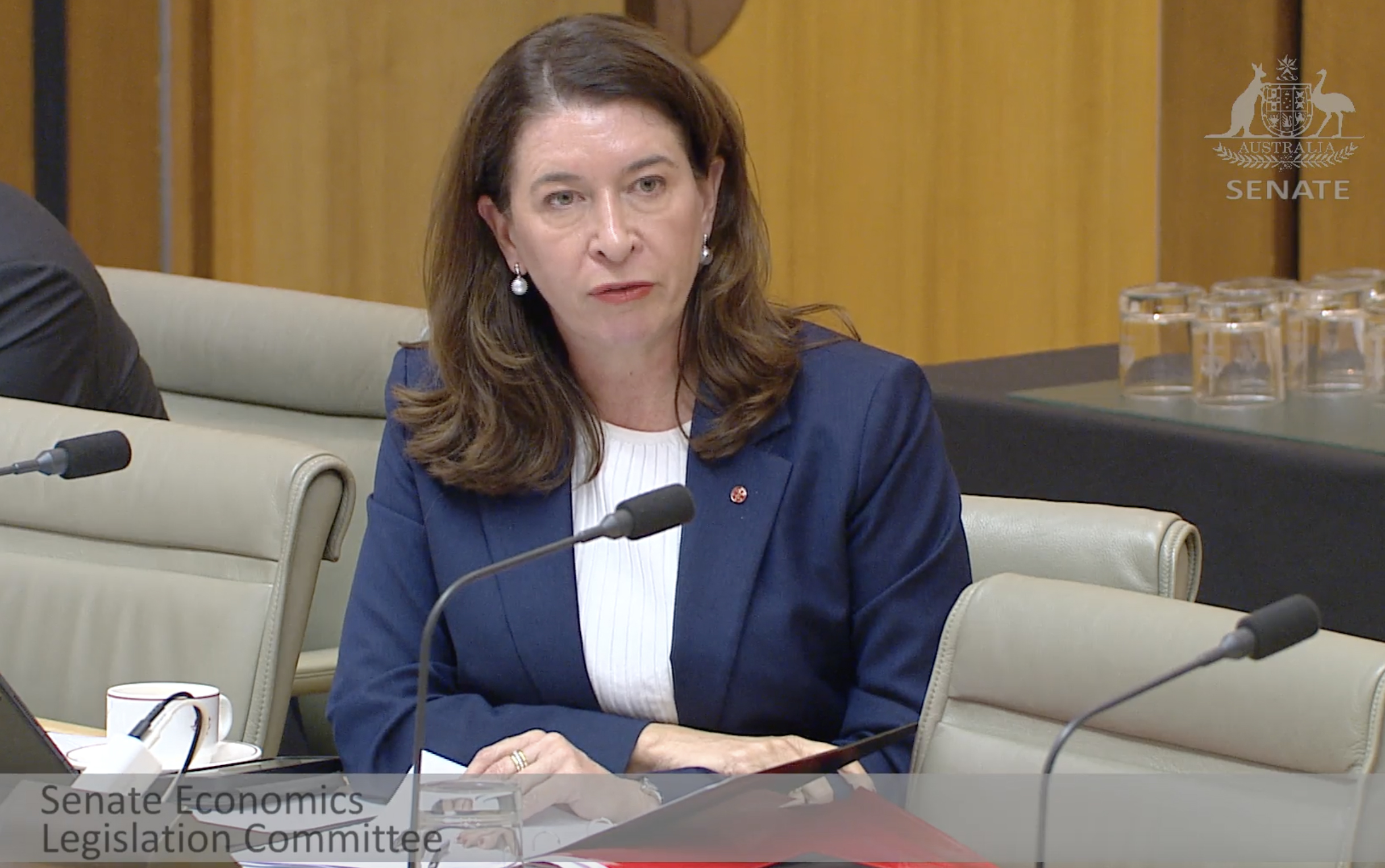
- ‘Australian Court Finds Context Is King in Clearing Oil Company Santos of Greenwashing' (Drilled, 9 March 2026).
- As a post-script to this important story, it is worth noting the ACCR filed an appeal last Wednesday as one of those I spoke to predicted.

- I joined the panel for The Weekend Shot to discuss Iran and all the weeks events:


- We also had a couple of Freedom of Information (FOR) wins. The first I am not at liberty to share just yet, but needless to say it appears I'll be getting a refund on a very large and excessive fee that, I believe, served as a deterrent. In a much smaller development, another FOI, I place following my reporting on the below story (click to see the decision in the second post) found that there were no documents. At the moment, it is not enough to generate a standalone story, but I do plan to follow up.
During an appearance before a senate committee in February, DISR departmental secretary said Australia's oil and gas industry welcomed environmental reforms as a "net positive". “Industry, as I understand it, recognise there’s an improvement in the new EPBC Act regulations," she said.
— Royce Kurmelovs (@roycerk2.bsky.social) 2026-03-18T01:26:02.019Z
Before You Go (Go)…
- Want to get in touch? Message me on Signal at username RoyceK.11. Alternatively you can send hard copies to: PO Box 134, Welland SA 5007
- And if you’ve come this far, consider supporting me further by picking up one of my books, leaving a review or by just telling a friend about Raising Hell!