Raising Hell: Issue 10: Costs Of Doing Business
"We decide what is right. Never mind what the people think.” - Lee Kuan Yew, Straits Times, 20 April 1987

I’m a simple guy. I want simple things: nice food, good bourbon, paid leave and a warm coat on a cold day. My list, however, tends to expand and thin with the seasons. Lately, for instance, you might even include another, more immediate item: transparent and accountable government institutions.
See, this last fortnight I’ve been quietly putting in a series of Freedom of Information requests to the Digital Transformation Agency as part of a deeper probe into the development of the COVIDSafe app contacting tracing app.
If you haven’t been keeping up, all you need to know on background is that the whole thing was an idiotic screw up. Way back during the pandemic’s first wave, the Prime Minister hinged the lifting of lock-down to the take-up of a medical app that was supposed to automate the process of contact tracing for those diagnosed with Covid-19. Since then it has been downloaded 6 million times (a figure that is wholly unreliable as a measure of active users) and has become a running joke given the code on which it runs has more holes than Swiss cheese.

Image: The COVIDSafe logo, because green means “good”. (Source: wikipedia)

As a story, this is the kind of thing tends to excite tech people and engineers. For those with the skills to run an autopsy on the code, the sheer number of errors in a multi-million dollar publicly-funded piece of technology designed for use by 26 million people is shocking.
It’s been my observation that these people are often unfamiliar with government processes — or for that matter, the insane managerial bureaucracies that exist within the top-tier of private corporations. It is only because government institutions have the capacity for democratic oversight that we tend to discover the extent of screw ups more quickly. When this happens, it becomes much easier to trace the extent of the problem and get a sense for scale. Over in the private sector, the petty fiefdom that is the modern corporation means similar screw ups tend to be kept quiet — at least until they hit the courts.
This, arguably, is why it has been so easy for various strands of academia, media and the business community to run the line that “mo’ private sector, mo’ better” for so long without challenge. It is also this divide that, for me, makes the story of the COVIDSafe app much more interesting. When you bring in the social, the legal and the political, it becomes more than a tale about a tech innovation gone wrong. Whether we realise it or not, any given piece of technology, from penicillin to the a-bomb, is a product of its environment. COVIDSafe is no different. This was how I thought about what I was doing as I put together my first story on COVIDSafe, looking at the legal technicalities required to actually protect people’s private information. What I learned then was that the interplay of information sharing arrangements across state and federal agencies meant there was almost no way the federal government could prevent information stored on a central service ending up in an Australian Federal Police database — despite their insistence to the contrary.
What I am now learning is how the COVIDSafe app is a window into a raft of deeper issues affecting public life. An example might be the idiotic way ministers and department heads keep dreaming about running public institutions “like a business”. Or how the ever-increasing army of third party private contractors are siphoning off ever-larger bundles of cash from the public purse. Or even, perhaps, how the government has become so obsessed with control and secrecy that it has entirely compromised its ability to do anything well with technology by threatening critical thinkers with jail time (more on this in coming weeks).
With this in mind — and with the help of my generous subscribers — I spent a good portion of the last two-to-three weeks daisy-chaining together a string of Freedom of Information applications to track the app’s development as a means to draw out these themes.
That, however, was somewhat complicated last week when I received an estimated costings on the first batch of documents. Of the three applications I made targeting three separate companies, the fastest response came back regarding the activities of the Boston Consulting Group (BCG). BCG is a US-based consultancy with a history of working with the Department of Home Affairs. The short version is that BCG were contracted in by the Digital Transformation Agency (DTA) to pull together a vast constellation of government departments, third party private contractors and spy agencies to develop COVIDSafe. Of course they were well paid for their services.
If you were to think that such arrangements should be heavily scrutinised by the public, I would agree. They should. Unfortunately, however, the DTA has now put a price on transparency by charging me $750 for the privilege of being told why I can’t read their emails:
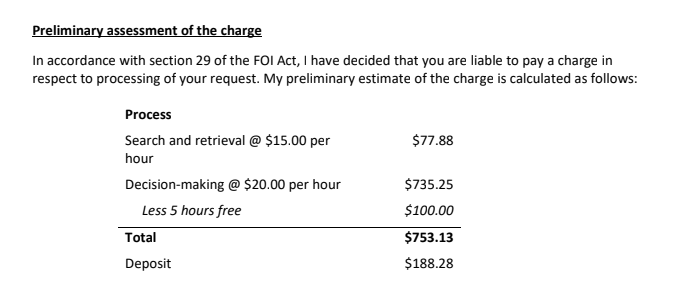
If you scan that table and feel like it represents a deterrent — real or perceived — to actually carrying through a Freedom of Information request, I would agree. I’ll be Raising Hell about this in the coming weeks.
Thing is, that takes money. While my generous subscribers have done much to support me through this pandemic — which has let me put together some really powerful stories that may not have otherwise got done — this newsletter does not generate enough cash to cover this kind of up-front production cost on top of everything else. With that in mind, I’ve been talking to Electronic Frontiers Australia about partnering and using this story as way to teach people about the Freedom of Information process.
This is important for reasons that go beyond the detail provided here. I am aware of several other reporters at major institutions engaged in similar projects, including The Guardian’s excellent tech reporter Josh Taylor, Ariel Bogle from The ABC and Denham Sadler at InnovationAus. While it is good to have these heavy-hitters working on the issue, the skills and knowledge involved should not be locked up among journalists and lawyers. My hope is that by working through this in public, people out there may learn from both my success and my mistakes to get a better sense of to run their own FOI applications.
As things take more shape, I’ll be following this process through as bonus content in the coming weeks — along with a few other expert QandA’s I have planned.
Until then, stay tuned.
Reporting In
Where I recap what I’ve been doing this last fortnight so you know I’m not just using your money to stimulate the local economy …
- ‘Legal action to fight uranium in drinking water in remote NT community fails’ (NITV, 2020).In what I’d consider a horror story, NCAT has dismissed a claim by the Aboriginal community at Laramba in the NT concerning whether landlords are responsible for providing water filters to clean out the uranium in their drinking water. I did the rewrite on the ABC story for this but when I put a series of questions in to NT’s public utility company Power and Water they declined to answer questions — a stance I don’t think is good enough.
- Visit with the Barngarla Determination Aboriginal CorporationI took a drive out north to Port Augusta last Monday to meet with the BDAC as part of a feature I’m working on, talking about the nuclear wasted dump proposed for Kimba. The story I’ve been putting together is long and complex, but talks about the issue from the perspective of the Barngarla.
- ‘Beer and Other Sins: Fire, gin and germ warfare on Kangaroo Island’ (The Adelaide Review, 2020).This week I filed another column with the Adelaide Review for the July edition, this time describing a perfectly ordinary night at the Governor Hindmarsh in otherwise extraordinary times. While that gets printed, my last column filed from Kangaroo Island has gone online.
You Hate To See It
A dyspeptic, snark-ridden and highly ironic round-up of the news from our shared hellscape…
- God Save The LandlordsAirBnb — in keeping with its stated mission to profit from gentrification — has asked its users to help struggling second (or third, or fourth) home-owners across the globe keep up with their bills after the global pandemic obliterated the short-term rental market. The company has created an electronic tool that allows users (who likely do not even own one house) to send “kindness cards” — that include cash donations — to their former hosts. In other words, their latest innovation amounts to little more than cutting out the middleman in the process of upward wealth redistribution.
- “The Robocops Of US Border Patrol”The US certainly doesn’t look like a failed state these days, no-sirree. I mean, it’s not like they have a virtually lawless paramilitary organisation running around with total political backing from the executive but are accountable to no one as they brutalise immigrants and bundle protesters into the backs of unmarked vans. …Oh wait.
- Brace For ImpactIn news that should probably worry you following Raising Hell’s reporting from last fortnight, Australian insurance company IAG will — for the first time since its incorporation — not be paying dividends to shareholders as it braces for the impact of the pandemic. The company — which has already booked a multi-million loss from extreme weather events — is now hoarding dollars in expectation that it will have to doll out millions more as the dust settles on the pandemic.
- Totally Absolutely Nothing To See HereIn a story that will shock no one, veteran libertarian and all-round annoyance Tim Wilson has been revealed to have leveraged his appointment as Human Rights Commissioner to book speakers for the Institute of Public Affairs and secure endorsements for his run at pre-selection. Wilson apparently failed to see why anyone may take issue with using public office for personal profit and fought the release of the emails under FOI, on the basis it was all “utterly irrelevant”.
- Following The MoneyIn a tale as old as time, Ashley Dodd, Chief executive of Shine Energy, has been revealed as money-hungry corporate vampire. It seems that the man — who has denounced renewable energy “speculators” and “economic terrorists” — had spent much time trawling renewable energy conferences across the country pitching his solar company to whoever might listen. According to reports, those who knew him said he frequently spoke about his company’s “passion” for renewable energy, as if this magic word would unlock a fat government contract. When it did not — thanks to a lack of experience, land, pre-existing commercial arrangements and capital — Dodd, now disheartened and bitter about being left out of the club, went to the darkside. There he landed a sweet $4 million government check to work on a feasibility study plugging a $2 billion coal power plant even the Queensland government doesn’t really want — and that’s saying something.
- Speaking Of Crooked…Closer to home, the South Australian Liberal government is inching closer to crisis after no less than four MPs were stood down after an expenses scandal promoted the Independent Commissioner Against Corruption to open up an investigation. The development does not bode well for Premier Steven Marshall whose majority has been shrinking since Sam Duluk was slapped with an assault charge for allegedly sexually harassing Centre Alliance MLC Connie Bonaros during a Christmas party. Given that his party’s plans for the next state election were leaked to the media, it is possible the Tories in the party are busy doing the math on the moderate leader’s future.
- Reds Under The Garden BedsA vicious hordes of chipmunks — fat and happy from a summer spent gorging on plentiful acorn — have been ruthlessly terrorising the homes of the wealthy living Rhode Island in the US. The working classes will no doubt welcome their adorable new comrades — whose life expectancy only lasts three years — in the class war.
Failing Upward
Where I recognise and celebrate the true stupidity of the rich, powerful and influential…
Devoid of ideas in the face of recurring crises, Australia’s political leadership has been casting around for a fresh new approach to current woes like a run-away SARS virus and rapid-onset climate change. Now it seems they have found it — by casting back 40 years into the past to take up the same ideas that created many of these problems in the first place.
Appearing on the ABC’s Insiders, Josh Frydenberg made “don’t fuck with the classics” a political slogan when he explained how he was taking his cues from Margaret Thatcher and Ronald Reagan to confront the challenges thrown up by 2020:
.@JoshFrydenberg on taking inspiration from Thatcher and Reagan:
— Insiders ABC (@InsidersABC) 12:22 AM ∙ Jul 26, 2020
"Thatcher and Reagan are figures of hate for the left because they were so successful. One got two terms, which was the maximum that you can get in the US. Margaret Thatcher got 11.5 years."
#Insiders #auspolThough clearly intended as another yet another smug attempt to troll the left, the interview was more revealing than Frydenberg may have anticipated, mostly for the frank admission that, according to him, success in politics was merely about winning elections and not about ideas or their content. I mean, it’s not like those ideas have a real and tangible effect on the lives of flesh and blood people. Who could have guessed those in power care about little other than deciding things and the trappings of their station? Certainly, not us here at Raising Hell.
Good Reads, Good Times
To share the love, here are some of the best or more interesting reads from the last fortnight…
Francis Wade, writing in The Baffler, has this review of a book about the history of tea and the development of early capitalism in India and China.
There is nothing I love more than watching Nine political editor Chris Uhlmann grow red in the face about “the knuckle dragging left” or thereabouts, especially as he is among the reasons why we can’t have nice things.
The knuckle dragging book burners of the intolerant left have purged another centrist. Bari Weiss quits as an editor for the New York Times opinion pages. "Twitter is not on the masthead of The New York Times. But Twitter has become its ultimate editor."
— Chris Uhlmann (@CUhlmann) 12:21 AM ∙ Jul 15, 2020Speaking of cancel culture, as news media in the Anglosphere has been engaged in something of a global freak out about the issue, there has been a couple of good things written about the subject in the last fortnight (much to my surprise). The first by Helen Lewish appeared in The Atlantic and described cancel culture as another innovation of “woke capitalism”. A second much shorter piece by Bonnie Kristian in The Week echoed the sentiment, saying the freak out over cancel culture is really just a bunch of middle class people with no other marketable skills stressing out about the possibility they may be stripped of what modicum of class status they have and the perks that come with it.
The second of these stories linked to an old interview with Barbara Ehrenreich in Dissent Magazine about how she helped coin the phrase “Professional Managerial Class” (PMC). In one anecdote, Ehrenreich highlights how those who belong to this social strata find it hard to make even a basic human connection to those who build their beautiful houses and fix their cars — even when they’re ostensibly on the same side.
In 2009, there was an event—part of an international series of socialist gatherings—in Detroit. There was a workshop at this conference, and I had invited a group of working-class people from Fort Wayne, Indiana, who I had become close to. About six or seven of them drove from Fort Wayne to Detroit, and they were mostly laid-off foundry workers: stereotypical white men—though, actually, not all of them were white. I was closest with one of them, Tom Lewandowski, who created a workers’ organization and was the head of the Central Labor Council in the Fort Wayne area. [At the event], they talked about what they were facing in the recession. And then some woman in the room who was an adjunct professor suddenly says, “I’m tired of listening to white men talk.”
Before You Go (Go)…
Are you a public sector bureaucrat whose tyrannical boss is behaving badly? Have you recently come into possession of documents showing some rich guy is trying to move their ill-gotten-gains to Curacao? Did you take a low-paying job with an evil corporation registered in Delaware that turns out to be burying toxic waste beneath children’s playgrounds? If your conscience is keeping you up at night, or you’d just plain like to see some wrong-doers cast into the sea, we here at Raising Hell can suggest a course of action: leak! Download the encrypted message app Wickr Me onto your phone or laptop and contact us securely at my handle: rorok1990.
If you’re lurking and like what you see, throw me a subscription to get my screeds straight to your inbox every second Tuesday — it’s free. If you like what I do and want to see me do more of it, throw me a paid subscription — it’s $5 a month or $50 a year. Are you skint? Or flush? Well, you can also pay what you feel I’m worth by setting your own yearly rate.
And if you’ve come this far, consider supporting me further by picking up one of my books, or leaving a review or just tell a friend about Raising Hell!