Raising Hell: Issue 3: The Trust Edition
"Trust, but verify." - Russian proverb made famous by Ronald Reagan.

In just this last couple of days, oil prices have tanked as producers have run out of space to store all that black gold they’re pulling out of the ground, crashing the futures market. Over in the US, conservatives have organised mass protest against restrictions on social movement in the name of Freedom™ that will likely kill their own supporters. Here in Australia $300 million in funding has been allocated to resuscitate Great Barrier Reef after the government spent years insisting to the world everything was like, totally cool with the Reef. Meanwhile the same figures who are busy directing the biggest corporate bailout in Australian history are so obsessed with their personal legacies and petty grievances, they have been bootlegging Malcolm Turnbull’s memoirs in a plot seemingly out of the Mean Girls franchise. Oh yeah, and Virgin Australia is going under, as forecast in an article I wrote for The Saturday Paper a few weeks back.

Health care workers stand in the street in counter-protest to hundreds of people who gathered at the State Capitol to demand the stay-at-home order be lifted in Denver, Colo., on Sunday, April 19, 2020. Photos by Alyson McClaran
Events keep coming fast and it is hard to keep up. Change is funny like that — and we are watching change happen. As much as the people who run the majority of nations in the English-speaking world are desperately attempting to bail water and ensure everything returns to business as usual as quickly as possible, I’m not so sure that is going to happen. At a global level the complete inability to deal with the crisis in the US means the worlds largest economy is looking more like a failed state than a superpower with each passing day. In historical terms, it’s an empire in decline. Meanwhile the model of globalisation it engineered — and heavily profited from — looks to have undermined itself. While it was successful in moving people across borders quickly, eliminating the risk of famine in most developed nations and — critically — made it very hard for totalitarians to sustain themselves, the ever-increasingly cycles of accumulation it relied on created massive inequalities in the developing world. The end result is a world richer than ever before, but one that is also smaller, angrier and more fragile…
In one sense everything is changing, and yet it is also not. If the conservative side of politics is fighting an impossible fight to preserve a status quo that benefits the interests of their constituents, the left have also misread the moment. Those who rushed to claim, in the opening weeks of the pandemic, the crisis was a challenge to capitalism that would bring about its inevitable collapse were mistaken. The events of the last fortnight should put that to rest. Every libertarian hustler with a media platform has surfaced to demand restrictions on movement be immediately lifted in the name of individual agency — and the Australian Stock Exchange (ASX). Meanwhile, every corporate group large enough to sustain an all-star team of accountants and lobbyists has been working to capture their share of government stimulus. As far as capitalism goes, this is old hat: a classic misdirection that works to clean corporate balance sheets by socialising costs and privatising profits.
All of which is why the present moment looks more like Russia in the 1990’s than Russia in 1917 — not that that means anything. For those of us who are more likely to be cleaning conference rooms than holding meetings in them, I think we are all watching — with an ants-eye view — the replacement of the existing neo-liberal market economy with a neo-nationalist market economy. Such change can be incredibly exciting for nerds who study things like political economy. It can also be scary for everyone else, though all it will really mean in practice (for now) is that the rich will continue to get richer while talking a lot more about how great it is to be on Team Australia.
But then, what do I know? If opinion is worth the paper it is written on, this is electronic. According to the market, this makes what I think worth about as much as a barrel of oil right now. Which, as a reporter, doesn’t bother me. My generous subscribers don’t pay me to gab, but to go out and find facts…
Reporting In
Where I recap what I’ve been doing this last fortnight so you know I’m not just using your money to stimulate the local economy …
- “Indigenous women and children camping near Adelaide after being stranded outside of closed APY Lands” (2020, NITV, 8 April)First up is a story about how the South Australia government got it right in helping Indigenous people from remote communities stranded in metropolitan Adelaide find alternative accommodation.
“Remote Aboriginal communities call for governments to support ‘Arks’ for most vulnerable” (2020, NITV, 8 April).
This story, however, was not so sunny and is worth me going into a little more depth with the productions notes as how it was created gives an insight into how government departments are operating right now.
Jack Latimore, editor of NITV, first broke news Indigenous communities in the APY lands had been asking for help to prevent a Covid-19 outbreak, but were instead being sent body bags by South Australian authorities (you can read it here). Most of the work on this follow up story was done by Jack Latimore, Rachel Hocking and Keira Jenkins. My contribution was to help wrangle a statement from the South Australian state government, whose approach to the APY lands during the pandemic has been to wait and see.What should have been a simple exercise was made painful when SA Health refused to answer basic questions. At first blush the state’s health authority initially said any Covid-19 questions relating to the APY lands should be directed the Department of Premier and Cabinet (DPC). When I followed up with a few extra questions, SA Health then directed all questions to the South Australian Police, saying the emergency declaration meant the cops were running point. When I checked with DPC, they confirmed that SA Health, in fact, were still the go-to place for medical questions.
If that sounds like I was given the run-around, that’s because I was. To be fair, SA Health’s media team did quietly apologise for, essentially, handballing public health questions relating to a vulnerable community to anyone else during an emergency. In the end, it took a full week of sustained questioning to get answers, but the following Monday I was eventually sent a four line statement. The communique included additional background explaining that, as of that day, additional personal protective equipment was on route to medical organisations in the APY Lands — weeks after medical authorities in the region had written to the ministers (in early March) saying they only had enough equipment to handle a small outbreak for four days. Here’s an excerpt from that letter: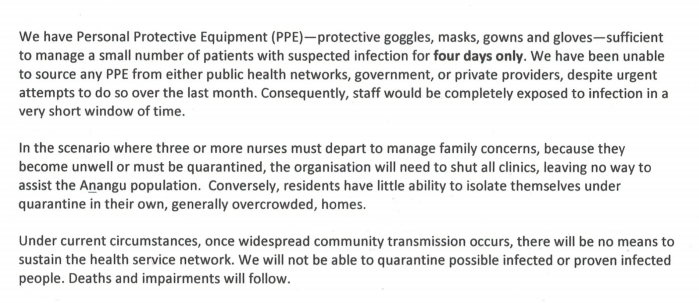
Beer and Other Sins: Lockdown Issue
Despite the pandemic The Adelaide Review is still making a valiant attempt to print in hard-copy which will hopefully run the latest installment of my Beer and Other Sins column about a sailor with a full bar who is recently out of quarantine.
Interviewed by Zoe Holman
Zoe Holman, reached out to have a chat with me about the connection between environmental politics and austerity politics after she read an article I contributed to The Observer in the UK about the bushfire crisis which made the connection. She’s putting together an academic chapter for a book, though I declined to be quoted.
- Interview by Mack Hogan of Road Track MagazineI was also interviewed last week by Mack Hogan who had to endure 45 minutes of me running my mouth about the Holden closure. The New York based journalist is putting together a feature on why the Australian car industry died — a subject I find hard to talk about these days.
- Additional Chapter (Just Money)Most of last week was spent writing an additional chapter to my upcoming book, Just Money for University of Queensland Press. The new epilogue is looking directly at how debt is shaping our response to the Covid-19 crisis and suggesting that the massive stimulus package we have seen over the last few weeks is not, in actual fact, a nascent social democratic revival but the largest corporate bailout in the country’s history. I’m considering releasing a draft as subscriber-only content, but that requires certain permissions. Stay tuned…
You Hate To See It
A dyspeptic, snark-ridden and highly ironic round-up of the news from our shared hellscape…
Global Pandemic? There’s An App For That…
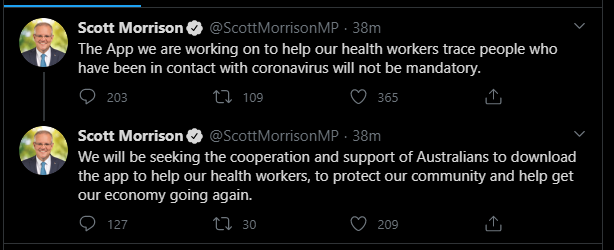
Triple M Hobart seemed pretty chuffed to have a call from the Prime Minister last Friday morning. During his spot, Scott Morrison urged every Australian to aid in the exercise of contact tracing by dutifully downloading a soon-to-be-released government-developed app that uses bluetooth to record their recent contacts. When pressed about whether he would make the app compulsory if there wasn’t enough take up, Morrison — weirdly — refused to explicitly rule out making it compulsory down the tracking, saying he wanted to give people “a chance to get it right”. Morrison’s attempt to preserve his options triggered a public panic as people freaked out over the “mandatory app”, forcing the PM’s social media people to make an official statement by Tweet days later clarifying that the app would not, in fact, be compulsory from the outset…
It’s A Tracking App That Absolutely Does Not Track You!
And to help sell the public on this tracking app idea, the government deployed none other than the paragon of virtue that is Government services minister Stuart Robert. Appearing on breakfast television show Sunrise, Roberts earnestly informed the public the tracking app would be perfectly safe, insisting: “no one has access to your data, no one is tracking you, there’s no surveillance.” It was a tough sell for Robert, given Australia is a Five-Eyes member state which legislated to force tech companies to install backdoors into encryption software and has deliberately shared the personal information of Centrelink recipients with in the media in retaliation for speaking out — an act which, for the record, appears to be sanctioned by law. It also helps, of course, that we can absolutely take Minister Robert at his word given he — as summarised in the last issue of Raising Hell — remains a figure of unimpeachable integrity. It’s enough to make you wonder if perhaps things would have been easier for the government if they had just pointed out how Uber already spies on you in exactly the same way the government plans to (just ask Beyonce) and no one seems to be rioting in the streets about that…
Seriously, You Can 100 Per Cent, Super Trust These Guys…
If anyone in government or the public service remains genuinely puzzled about why the masses were reacting so badly to even the hint of a mandatory tracking app, the High Court might provide some answers. In a unanimous judgment handed down last week, the court held raids carried out by The AFP against Newscorp journalist Annika Smethurst were absolutely illegal, but the Feds could hang onto the information they seized. The decision means the AFP can now use the material to shape future prosecutions against whistleblowers. If the implications of this High Court ruling weren’t grim enough for public interest journalism, The Parliamentary Joint Committee on Intelligence and Security that was set up to investigate the use of police powers against journalists and was due to report last year, has not. The release of its report has since been postponed, perhaps indefinitely.
No, For Real, You Can Totally Trust These Guys…
And here is your timely reminder that Peter Dutton has been holding onto plans since 2017 to make it a crime for people to hand over their password to the police in the name of — you guessed it — fighting pedophiles and terrorists. Under the proposal, a person who refuses to handover their password can be fined up to $50,000 and may face five years in prison. Frankly, this one is so grim it is almost impossible to snark on, as it already reads like a joke. But isn’t.
- If You Can’t Beat ‘Em…In a shock twist from the UK, the right wing of the British Labour actively undermined the leadership of Jeremy Corbyn in the hope engineering a crushing defeat at the 2017 election which would see Corbyn dethroned. While Labour MPs were apparently mortified a guy who actually promised to do stuff for the British public grew in popularity, senior staffers joked privately about “hanging and burning” Corbyn. These revelations echoed similar events in the US whose citizens, like the UK, will now get to choose between two conservative candidates after former President Barack Obama “won back the Democratic Party”. The former President, who won on a campaign of “hope and change”, welcomed the decision by Bernie Sanders to drop out and has now offered his services to Biden (the safe candidate) as youth whisperer.
- Sweden, Noted Small Government Utopia, StumblesAs borders snapped shut in the opening days of the pandemic, small government libertarian types turned to Sweden as a beacon of hope and individual liberty in the darkness that came with massive direct government intervention. Unlike other nations, Sweden declined to close its border or order its people into their homes to stem the spread of Covid-19. In a sign that all is going well for the country of 10 million people, Sweden recorded 1580 deaths as of this morning. Meanwhile, the small government propagandists at US magazine Reason have been frantically spinning the statistics to save face.
- The Ol’ Bait and SwitchAnd in wonderful news from my home state, the voice of the oil and gas industry has applauded South Australia’s decision, made under the cover of the Covid-19 crisis, to allow oil companies to drill, baby, drill free of taxes and licence fees, at least until December 31, 2020. The world-class decision by the state government means South Australia can now be counted among entire nation-state’s who have been quietly rolling back environmental protections and bailing out fossil fuel companies while everyone’s attention is turned elsewhere. Merry Christmas from the people of South Australia, oil companies! We’ll see your accountants in Q3, 2020-2021.
Failing Upward
Where I recognise and celebrate the true stupidity of the rich, powerful and influential…
If the country has embraced a semblance of collective action to address the pandemic, a chorus of media commentators and talking heads seized on the falling death count this last fortnight to attack that budding community spirit. Rather than stay locked in our homes, they are now insisting we rapidly open back up so people may resume spending at pace
A brief list of those urging nan to take a bullet for the ASX include, in no particular order:
- John Kehoe, The Financial Review, asking the provocative question: “Lives matter but at what cost?”
- Sam Lovick, The Financial Review, arguing: “The next stage must be to let the virus spread”.
- Gideon Rozner and friends, Institute of Public Affairs, who scored an appearance on The ABC to demand we “end the lockdown now”.
- Adam Creighton, The Australian, stating: “Let’s hope the economic train crash is worth it”.
- Pru Goward, The Sydney Morning Herald, declaring: “Baby boomers won’t like it but next step after lockdown is herd immunity”. On background for those living somewhere other than Sydney, Goward is the former New South Wales state minister for Family and Community Services who is remembered for her chequered track record in that role.
- Elizabeth Farrelly, The Sydney Morning Herald, proclaiming: “The Great Lockdown is a sledgehammer busting dreams that won't bounce back”. Farrelly is another personality, a political figure who once served on the Sydney City Council and whose Phd is in architecture, not virology.
The one that received the most attention, however, was the screed Chris Uhlmann, as political editor, committed to The Sydney Morning Herald titled: “If a grandparent chooses a loving embrace that may kill them who are we to stop them?” The former ABC journalist and member of the Canberra press gallery began by laying it on thick when he wrote a “long, dark road to Winter lies ahead as we march between the epochs of BC and AC: Before and After Coronavirus”. If the stakes weren’t already high enough, Uhlmann then upped the ante again from biblical to apocalyptic:
The dire economic equation does not include the probability that this plague will spawn other crises. You don’t have to be an epidemiologist to know what prolonged worldwide poverty will bring. War. Famine. Civil unrest. The collapse of regimes. The rise of ultra-nationalist governments and extremist movements on left and right. Murder. Suicide. Domestic violence.
All of this was a long-winded way to set up Uhlmann’s chief exercise: running a back-of-the-envelope cost-benefit analysis. Putting aside the sociopathy involved in framing the problem to implicitly accept human sacrifice as the cost of doing business, the entire mental exercise was presented as if Uhlmann were actually reading a physical ledger:
In balancing the health and economic side of the ledger it has to be understood that the currency of both is people’s lives. An honest assessment of the balance sheet is that the disease, mostly, threatens older Australians and the cure is falling like a hammer on the young. This is profoundly unfair.
It shouldn’t be necessary to say this, but this “ledger” exists purely in the imagination. Matters of public health are not zero sum against issues relating to the distribution of resources (the economy). The sick and dying, after all, tend not to shop for anything more than pharmaceuticals. In fact, the only people seriously making the argument right now that The Economy > Public Health are those with money who are more concerned about the financial well-being of other people with money.
Should we as a nation follow their advice and move swiftly to return to normal, you can be sure these same voices would not be among the “two-to-three” per cent affected by a potential second-wave of infections — and if they ever were, their wealth would guarantee them timely medical treatment. It would be the food delivery rider and the supermarket basket cleaner taking the bullet.
And this is without getting into the cynical hand-wring over the future of The Youth — a theme present in Uhlmann’s work and several other similar contributions. Setting aside the reality that our biosphere is in the process of collapse, nothing screams “dead dreams” like a future where mask-wearing is mandatory in public spaces, life expectancy has been suddenly shortened because of a runaway SARS virus and the iniquities of daily life remain entrenched. Alone this would be galling enough without the closing lines that just stop short of advocating the elderly be set adrift on an ice flow:
If a grandparent chooses the hugs of a grandchild over the chance that a loving embrace might one day kill them who are we to say it’s not their choice to make?
And in the interests of full disclosure, in the opening stages the pandemic, I too was skeptical about whether the “two-to-three” per cent death rate was an issue. I, however, have the good sense to double check my initial skepticism by following basic journalistic practice. I read the official reports available at that time and talked it over with people who had expertise — some of whom, shockingly, could be found on Twitter. All were quite happy to explain why I was wrong — and for good reason. I learned then that what mattered was the interplay of population size, population density and access to medical care. These influenced death rate, but also showed how the real risk arose from transmission. At the point hospitals become overwhelmed, it wasn’t just the old who died, but the immuno-compromised, asthmatics, cigarette smokers — certainly any other patient with any other illness who might need a ventilator.
I, for what it’s worth, remain quite happy to admit when I have been a fuck up and to adjust my worldview accordingly when I learn something new. In saying that, it is perhaps easier for me to understand these things. Thanks to my subscribers, my salary does not depend on my misunderstanding the issues…
Good Reads, Good Times
- The Colombian Organized Crime Observatory have put together a four-part report looking at the role women play in South American organised crime. It is worth a read for the way it cuts through the depictions of cartels in film to drive home the horrific realities of criminal activity. And, as an side, let it be known that gangs in Brazil’s favelas have been more responsive to the pandemic than the US government.
- Naomi Forrester-Soto from Keele University has an explainer in The Conversation about how new viruses originate which is worth a read.
- If the commentariat are attempting to deploy a cynical concern for the young in order to advance business interests, the antidote might just be this personal essay published in Wired. It talks about how young people who have been systematically screwed have consistently tried to compensate by ruthlessly optimising their lives to feel more in control — something not possible in a pandemic.
- Australian authorities might be working hard to ensure everything returns exactly the way it was before the pandemic, but the rest of the world isn’t so convinced. The best thing I have seen written about the world economy and Covid-19 to date comes from Adam Tooze in Foreign Policy with an analysis titled: “The normal economy is never coming back”.
They Say The Camera Adds Ten Pounds (Of Pressure)
Far be it from me to question why John-Paul Drake, director of Drakes Supermarkets, has his own Youtube channel, I did respect the moment the grocery baron flipped off grocery hoarders on camera. Drake was speaking about a customer who had tried to return 150 units of 32 pack toilet paper they had panic bought when he stared down the barrel of the camera and let loose. Consumer Law be damned.
Check this stunningly earnest television news report from Channel Nine about “another Coronavirus casualty” — the $4.5 billion parking industry. Seems even the forces of Big Parking are setting themselves up for a bailout. How Jesus wept.
For a refreshing reminder horrible stuff other than Covid-19 is still happening out there in the world, check this video of Peshmerga fighters casually clearing IED devices using nothing more than a pick axe and a pair of wire cutters.
Before You Go (Go)…
- Are you a public sector bureaucrat whose tyrannical boss is behaving badly? Have you recently come into possession of documents showing some rich guy is trying to move their ill-gotten-gains to Curacao? Did you take a low-paying job with an evil corporation registered in Delaware that turns out to be burying toxic waste beneath children’s playgrounds? If your conscience is keeping you up at night, or you’d just plain like to see some wrong-doers cast into the sea, we here at Raising Hell can suggest a course of action: leak! Download the encrypted message app Wickr Me onto your phone or laptop and contact us securely at my handle: rorok1990.
- If you’ve come this far, consider supporting me further by picking up one of my books, or leaving a review or just tell a friend about Raising Hell!