From The Notebook: Your Land, Your Choice?
“They’re coming to take our country again, just this time without the muskets,” - Raymond Weatherill.
In mid-September I travelled to the Pilliga in central New South Wales to meet with members of the Gomeroi, traditional owners of the region, and learn about their fight against Santos’ proposed $3.6bn gas expansion. As this trip was funded by Raising Hell subscribers, I have published a raw write up of my notes and observations. This is not a fully processed work of journalism, but functions more as a background sketch on an issue that, in the wake of Juukan Gorge, will reach its crescendo in coming weeks.
The wind made it hard to breathe. It was only a 25m climb up the steel steps of the firetower, but the cold front sweeping in from the west hit hard. As those at the top looked out over the Pilliga scrub in central New South Wales, they had to lean into the wind so as not to feel like they would be blown away.
According to the Bureau of Meteorology a powerful cold front had hit South Australia the night before and was starting to make its away across into New South Wales. When it landed it would bring severe thunderstorms and up to 40mm of rain in some parts, creating a risk of flooding. It was only noon but the sky had already begun to bruise and everyone knew they were on a clock.
The view from the top helped put a few things in perspective. A panoramic compass on the roof marked the direction of the nearby towns — Narrabri, Bulgadie, Coonabarabran. At half a million hectares, this was the last remaining scrub forest west of the Dividing Range. It was one fact that really drove home the significance of the next: this was place where Australian oil company Santos plans to drill 850 new gas wells as part of a $3.5bn fossil fuel expansion.
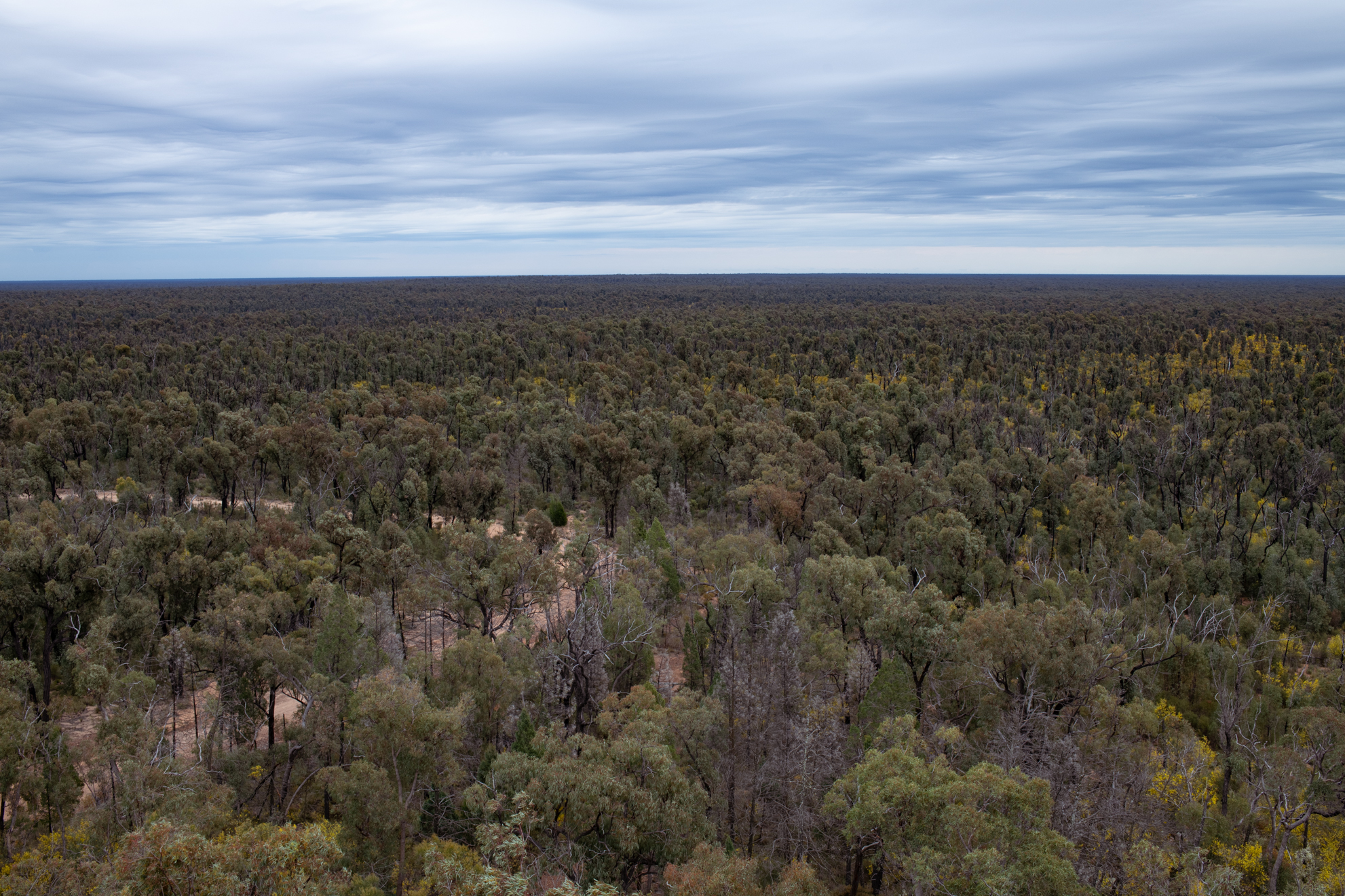
View from the firetower (Source: Isabella Moore)
The Narrabri project has been a decade in the making. Under the plan, 1000 hectares of state forest and privately owned farmland would be scoured clean to prep each site. Drilling would dig 1200m below the surface to extract 1500 petajoules of gas. When complete, the wells would pock-mark the Pilliga.
So far Santos has solemnly promised the gas pumped from Narrabri would be exclusively used to supply the domestic Australian market and alleviate alleged gas shortages on the east coast. Though 23,000 submissions were lodged in opposition to the project, the federal Coalition’s plans for a “gas fired recovery” cleared the way and in October 2021 Santos was given the green light. The company “welcomed” the response saying it looked forward to “getting on with our work in regional New South Wales to create jobs, drive investment and bring long term energy security to the state at competitive prices.”
As one of 143 new fossil fuel projects pending in Australia, the expansion feels out of step with the government’s current rhetoric on climate change. Last year the International Energy Agency (IEA) said limiting global warming to 1.5C as set out in the Paris agreement meant there can be no new oil, gas or coal investment beyond 2021. In June 2022 UN Secretary-General Antonio Guterres’ went a step further when he called called for an end to fossil fuel use saying “fossil fuel producers and financiers have humanity by throat”.
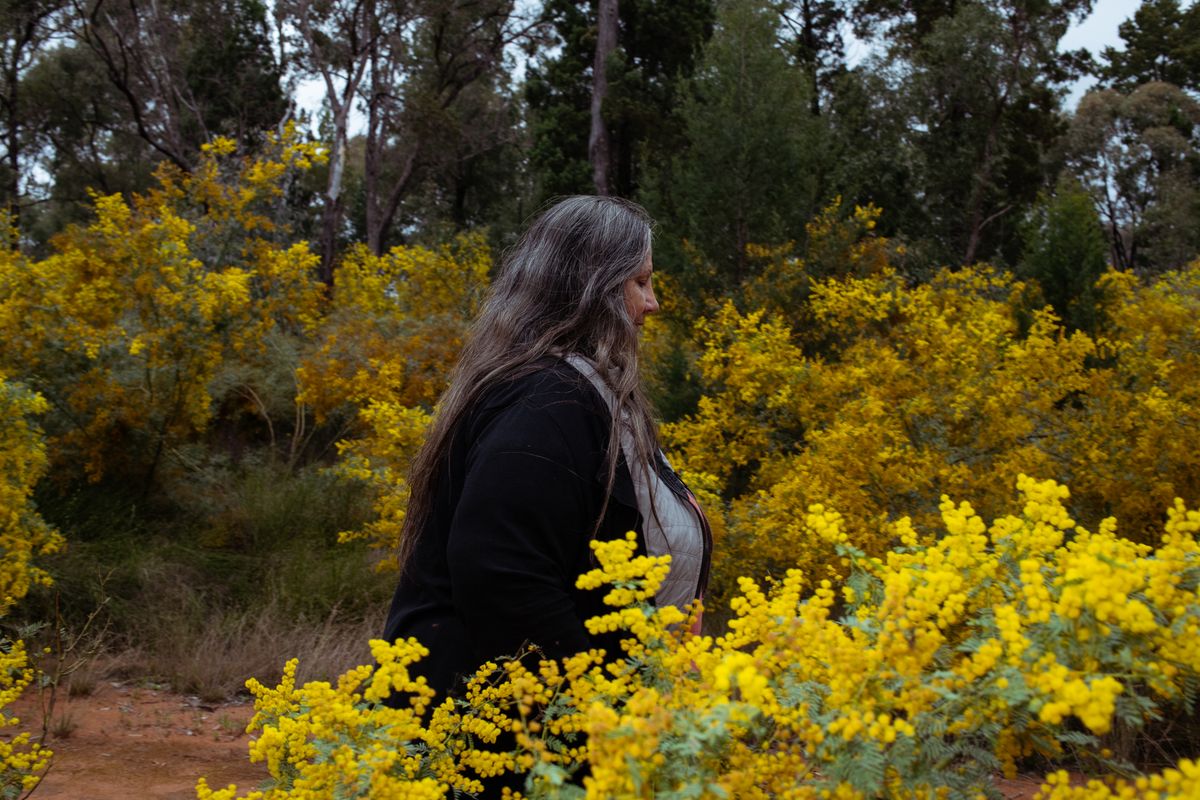
Locally federal Labor has so far refused to constrain new fossil fuel development since taking government. Now as they wait for a decision in their legal challenge, here on the ground in the Pilliga Gomeroi woman Suellyn Tighe says they are already noticing how climate change has warped the local ecology. At this time in middle September the wattle blooms across the Pilliga in a vibrant yellow but Tighe says everything is out of whack. Pointing to features of the scrub, she explains how everything is growing either too fast, or too slow and the usual rhythms through which plants and animals interact are breaking down.
As much as the Narrabri project is a cause for environmental activists and climate change groups, the issue of Indigenous sovereignty and self-determination for First Nation’s people runs right through like a fault line. On one side there is a company determined to crack open a new fossil fuel field, on the other there is the Gomeroi working to decide the fate of their traditional country. The terms of this exchange came to a head during a recent skirmish in May when Gomeroi woman Dorothy Tighe stood during a Santos annual general meeting in Adelaide and symbolically served the company’s chair Keith Spence with a cease and desist notice. Though it had no legal effect the moment forced a sharp focus on the confrontation.
The issue involves an allegation by the Gomeroi that Santos failed to follow proper process. In late 2011, the Gomeroi filed a native title claim over a sprawling area of New South Wales that included all of the Pilliga, meaning Santos is required to consult with the Gomeroi before forging ahead on the project. In March 2022, at a time when the Omicron variant was spreading, the Gomeroi were forced to a nation vote on whether to give Santos permission to drill. The result was a resounding “no”. Among 162 participants, only two voted in favour of letting Santos proceed and four abstained. Everyone else voted against.
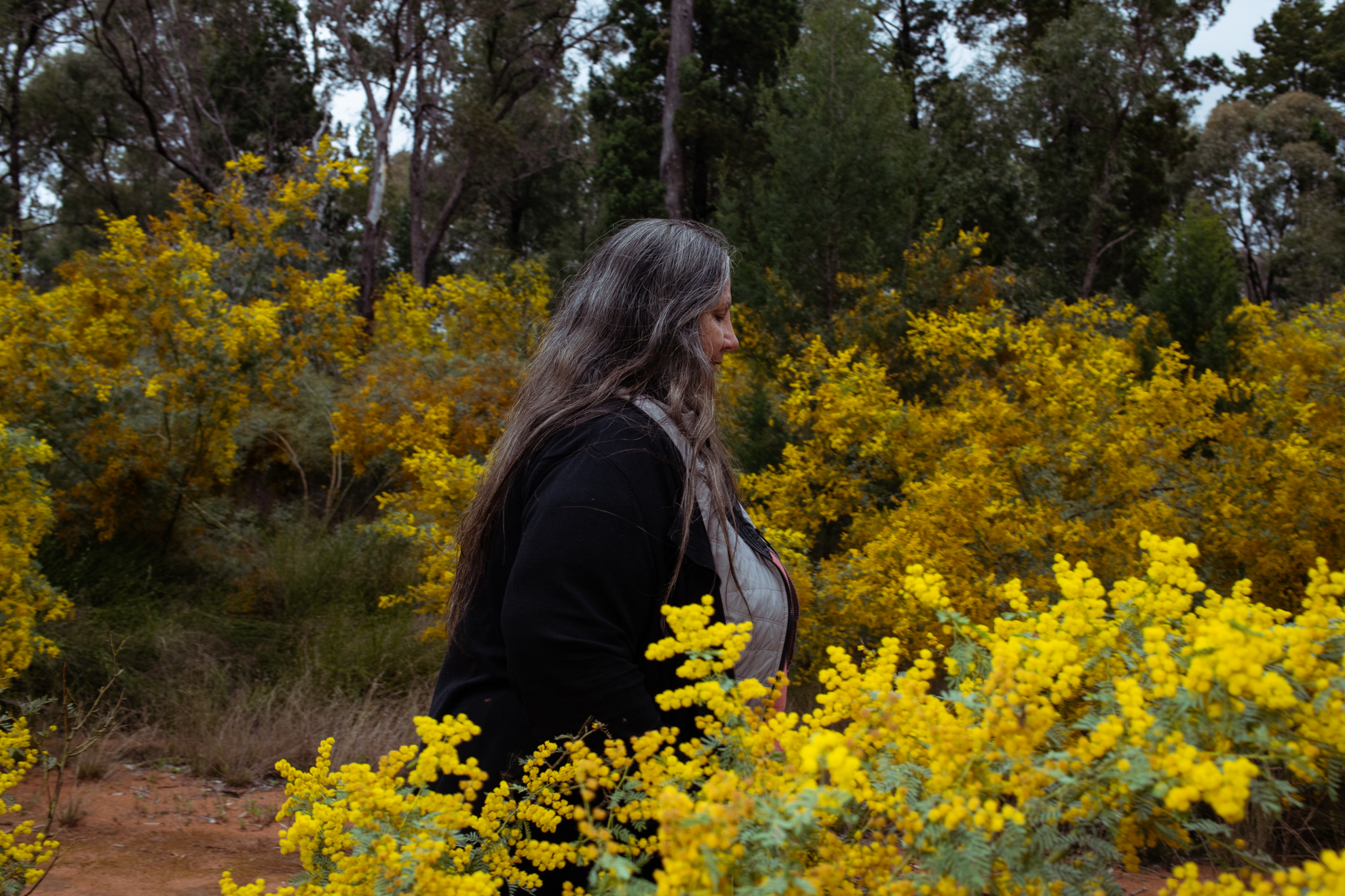
Suellyn Tighe says climate change is already changing the local environment (Source: Isabella Moore)
After ten years and hundreds of millions of dollars, there was no way Santos was going to let the decision stand — a story that was becoming increasingly emblematic of the way the company does business with First Nations people across Australia. In response, Santos immediately applied to the National Native Title Tribunal to overrule the vote and push on with the work. In that moment any pretense of collaboration between the company and First Nation’s people fell away. Gomeroi man Raymond Weatherill described it as a sense of history repeating.
“They’re coming to take our country again, just this time without the muskets,” Weatherill said.
As part of their decade-long fight against the project, the Gomeroi nation have been running tours to the site — as has Santos. Where the Gomeroi take curious reporters, activists and researchers on fact finding tours to walk the perimeter, Santos also runs its own trips to the handful of test drill sites in the area. Across the industry this is talked about as “building social licence”. It describes the process of getting people familiar with an industrial operation next door so they make peace with its existence. In Narrabri, a Santos shopfront operates nine-to-five on the main street — staffed by the kind of people that wear sleeve-less puffer jackets, clean flannel and RM Williams boots. The company has even set up a dedicated website: www.narrabrigasproject.com.au. According to the website, site tours out to the handful of test wells they already have in the area run on the third Thursday of each month. The website’s slugline reads: “your land, your choice”.
Finding the existing wells requires a guide. Most are hidden away in the scrub, down a series of dirt roads most have no reason to enter. Signs on the gate warn anyone who gets to close they are being watched, either through the closed circuit television of the facility itself or on the trail cameras monitoring the area for the presence of activists. The sites themselves are not much to look at: the bush has been scoured clean, levelled and covered in gravel or asphalt to make a work surface. Towards the back the concrete walls of an evaporation pit rises. A storage tank, the colour of khaki and surrounded by a small plastic-lined moat, holds the gas extracted from the well — an unremarkable cluster of pipes off to one side that plunge deep into the earth and the coal seam below.
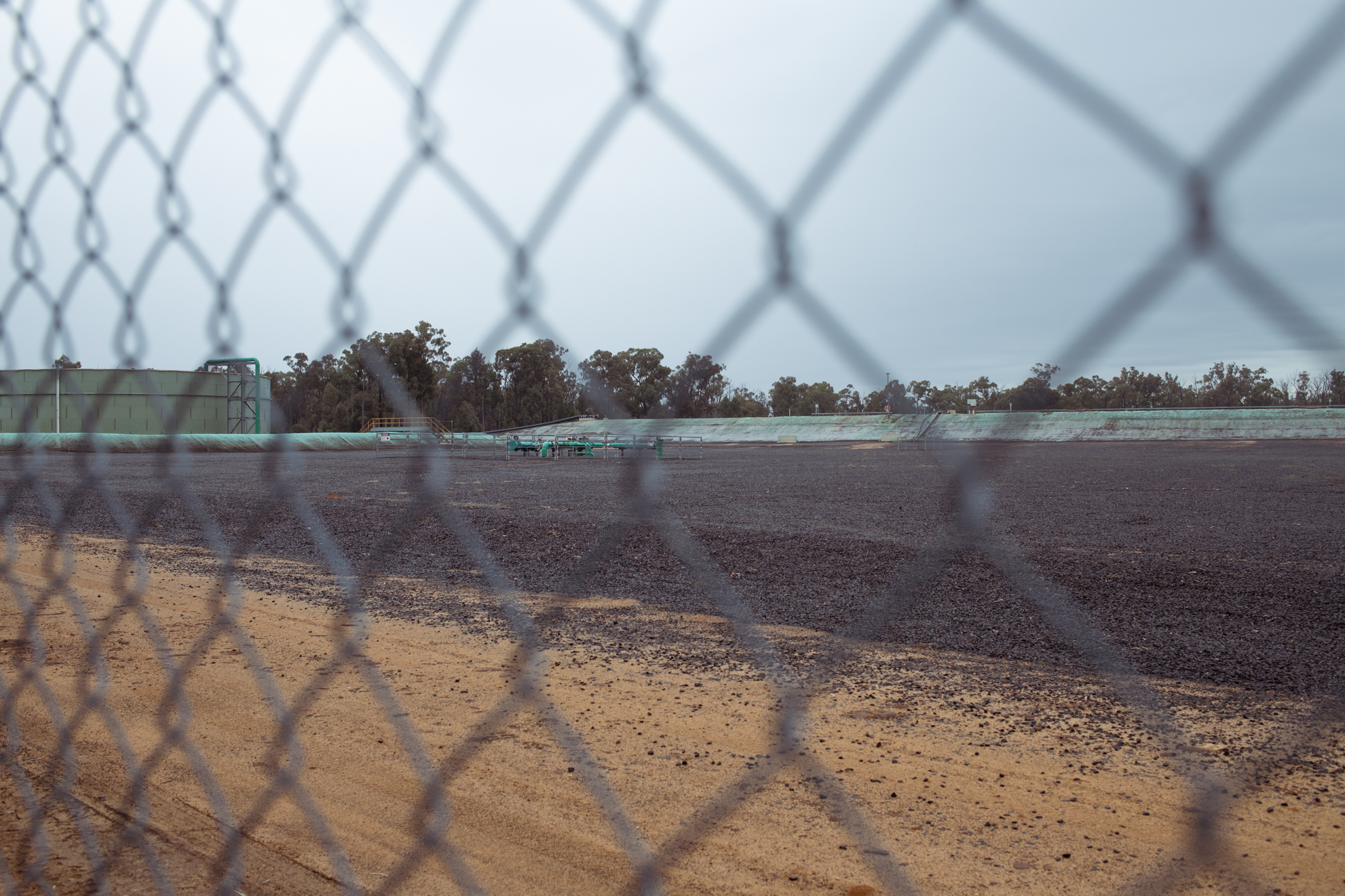
View from the fenceline at test well (Source: Isabella Moore)
For all the talk from the company about how the expansion would created 912 full-time jobs, there isn’t a soul present at the site at the time. Everything is monitored remotely by small, off-site teams who check the cameras and the readings before responding as a situation develops. This isn’t to say there will be no benefit to some locals. It was reported in August Narrabri’s mayor, Ron Campbell was in discussions with Santos for his waste disposal company to handle the 33,600 tonnes of salt and chemical waste the drill sites would produce each year. This was the equivalent of four Eiffel towers a year.
Walking around the perimeter of the facility, past the temporary fence set up to cordon off a spill site from a decade ago, the rain began to fall. It came softly at first but began to pick up as we made our way back to the car. Driving through Narrabri on the long-way back to our motel the rain beat a familiar rhythm on the windshield. Two years ago, not far from here, the mighty Namoi river ran dry and the catastrophic Black Christmas Bushfires tore their way south from just below the Queensland border down into Victoria. A couple months back the rivers of New South Wales grew swollen under torrential rain as a dry, parched earth began to flood. At the time the public had responded with a righteous anger. If there was an expectation that something had to change, it was still an open question about whether anything had.
Before You Go (Go)…
Are you a public sector bureaucrat whose tyrannical boss is behaving badly? Have you recently come into possession of documents showing some rich guy is trying to move their ill-gotten-gains to Curacao? Did you take a low-paying job with an evil corporation registered in Delaware that is burying toxic waste under playgrounds? If your conscience is keeping you up at night, or you’d just plain like to see some wrong-doers cast into the sea, we here at Raising Hell can suggest a course of action: leak! You can securely make contact through Signal or through encrypted message Wickr Me on my account: rorok1990. Alternatively you can send us your hard copies to: PO Box 134, Welland SA 5007
And if you’ve come this far, consider supporting me further by picking up one of my books, leaving a review or by just telling a friend about Raising Hell!