Special Issue: Means, Motive and Opportunity
"I put him there and I'll put him out," - Keith Murdoch, speaking of his support for Joseph Lyons, 1936.
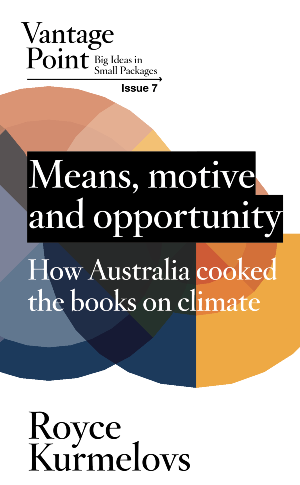
Below is an excerpt from the opening sequence of my upcoming essay, Means, Motive and Opportunity, that will be published by Vantage Point Press on 9 November 2026. It is one of two essays I have in the pipeline, with the second to arrive early in 2027. This work tracks how industry captured an Australian government agency responsible for the production of agricultural statistics and used this relationship to shape how this country thought about climate change from the very beginning. It is a forensic account, based on documents obtained with financial support by Raising Hell's paying subscribers, whose contribution paid for the time, hotels, and travel needed to pour over thousands of pages of forgotten documents in the National Archive. The opportunity for this essay, which links together several previous reports into a cohesive whole, was unexpected but valuable as this type of journalism is extremely rare in Australia and I wanted to share this excerpt as a thank you to those friends and supporters who have stuck with me all this time.
An additional note: some financial subscribers do not seem to have been migrated across when I shifted from Substack to Ghost over concerns about publishing to a platform which gives free reign to Nazi's. I have since gone back to manually input each subscriber into the new platform. Each will subscription will continue to be paid through Stripe (due to technical difficulties involving the Substack backend), but you should also get access to emails through the Ghost platform going forward. If you are suddenly getting an email now, after months of radio silence, that is why—I apologise for the kerfuffle.
It is not men or machines that make a coal mine work. Sure, it takes steel and dynamite and an ocean of beer in a place like New South Wales’s Hunter Valley to peel back the skin of the earth, scrape out its innards and haul it off to be burnt in a furnace somewhere.
But what it really takes is ideas.
Before men and machines can begin, someone needs to conceive of what a coal mine represents. They have to envisage a river of gold where a coal seam runs, and then, especially in this day and age, they have to find a way of getting everyone else to envisage it, too. Money is the tool of choice when it comes to this act of persuasion, but even that is an abstraction. That is what makes ideas, like those which make a new coal mine possible in 2026, just as lethal as its operation.
Take, for example, the prosaically named Hunter Valley Operations (HVO) in central-eastern New South Wales. When the first pick struck the ground near Whittingham, just south of Singleton, in 1949, few had any idea what the site would become, or what it would come to mean. In the United States, industry was well aware that it was dangerous to keep burning oil, gas and coal as early as 1954, and they certainly knew by 1968. Australia was slower on the uptake, but most of the country’s resources sector understood the potential for harm by around 1971. That year, a corporate precursor to the Australian Minerals Council brought out Kenneth Nelson, a scientist from the American Smelting and Refining Company, to give a briefing on the issue.
“Carbon dioxide is really the only contaminant which we can say is proved to be accumulating in the global atmosphere,” Nelson said. “Apparently it is being generated somewhat faster than it can be removed. The atmospheric CO2 concentration is currently about 330 parts per million—up from a bit under 300 parts per million fifty years ago. No cause for alarm, but worth watching on a global scale.”
So, over half a century ago, Australia’s coal companies knew that fossil fuel extraction and consumption were altering the chemical composition of the atmosphere in such a way that would have consequences, but they kept at it anyway. The idea they might give up all that money was unthinkable.
After 70 years of operation, HVO is one of the biggest mines in New South Wales, and the state is one of the biggest coal mining regions in the world. Coal is the state’s biggest export, valued at about $33 billion, far eclipsing the next two exports—educational-related travel and gold. In 2023 to 2024 alone, five coal fields across New South Wales produced 173.5 million tonnes—about 30 times the weight of the Great Pyramid of Giza and three times as heavy as the Three Gorges Dam in China, the largest concrete structure in the world. Only an eighth of this coal was destined to burn in Australian power stations. The rest was exported across Asia.
Activity at HVO revolves around the north and south operations—HVO North and HVO South—each made up of interlocking open-cut mining pits covering an area of around 140 km2 and reaching some 515 metres underground. This makes it deeper than Uluru rises and about 300 times the size of the Vatican. In 2020, its owners, Chinese state-backed coal miner Yancoal and Swiss resources giant Glencore, began talking about how this was not enough. The Black Summer bushfires had just burnt their way along Australia’s east coast, and in 2022 the northern New South Wales town of Lismore drowned in catastrophic flooding attributed to the effects of these fires and, by extension, climate change. None of that changed the fact that there were still at least 684 million tonnes of thermal and coking coal in the ground at HVO. The mine’s owners wanted every last gram of it.
What matters here is not so much the specifics of the case these companies made to justify their proposal, but rather whom they turned to for ideas to help convince authorities and the wider public that it was worth it.
In May 2020, Yancoal and Glencore commissioned the consultancy firm Ernst & Young (EY) to produce an “economic impact assessment” to illustrate the benefits of extending the mine’s operations to at least 2045. When the report was delivered two years later, it was signed by a man named Steve Brown. Before EY bought out the consultancy firm Brown founded, Cadence Economics, and made him a partner, he had spent 15 years at the top of Deloitte, Access Economics and ACIL Tasman. It was, however, his five years at the Australian Bureau of Agricultural Research Economics (ABARE, pronounced A-BEAR) that taught him the skill that would set him up for life: economic modelling.
If this story were to have a villain, it would be ABARE. A successor agency, ABARES, continues to this day but is not a focus of this essay. Established in the late 1980s, ABARE’s work during this period would prove deadly. Framed in true-crime terms, the fossil fuel industry would find in ABARE the means and opportunity to attack the idea Australia might act early on climate change. ABARE would willingly collaborate in this act of “slow violence”, a gradual and almost imperceptible accumulation of harms that added up to something significant. The bureau’s work would shape how Australians thought about climate change for two decades and the ideas it developed continue to be used to convince powerful people that gambling with the country’s future is still worth it.
On paper, Brown’s cost-benefit analysis for EY suggested there wasn’t much to argue about. Based on the same methodology developed by ABARE, the 88-page document concluded that extending the working life of HVO South alone would bring a $4.8 billion net benefit to New South Wales. It was a spectacular figure, equivalent to just under half the $11 billion valuation given to the Sydney Opera House in 2023, the single highest projected benefit ever submitted by a company to state planning authorities, and nearly twice what had been proposed during the Bulga coal mine expansion in 2012.
The eye-watering sum of money seemed impossible to refute, especially when compared to what the report said the mine’s extension would contribute to climate change. EY concluded that the additional 684 million tonnes of extracted coal would result in greenhouse gas emissions amounting to a measly $1.3 million. This figure was calculated “based on a ratio of NSW population and global population (on average 0.33%) multiplied by the GHG [greenhouse gas] global emission cost”. The cost of those emissions was lifted from the US Environment Protection Agency’s Social Cost of Carbon, a measure in dollars of the long-term damage done by a ton of carbon dioxide in a given year.
Taken at face value, the contrast was stunning—the figure was a rounding error by comparison. The mine’s operators would spend more money on diesel fuel in any given year. The impossibly low number was achieved because, as the report noted, there was nothing in the regulations that required the mine’s operators to think about the emissions that would be created when the coal they extracted was eventually burnt. These “Scope 3” emissions were someone else’s problem.
The logic behind Brown’s case in favour of the mine’s expansion was simple. Imagine two worlds, one with a bigger coal mine and one without, then compare them to see what the differences are. In the world without a bigger coal mine, the 1,500 or so people who currently worked the pit would have to find jobs outside mining, stacking shelves at Bunnings or flipping burgers at McDonald’s. They would not be paid as well, nor would they be alone in their misery. Businesses in the supply chain who did everything from making lunches to doing taxes would face a drop-off in demand and would not, allegedly, command the same prices for their goods and services.
Compare the numbers and the future looked better with more coal.
This was a slick idea, one with a long history. For decades, Australians have been told that doing anything meaningful to mitigate climate change would spell disaster for the economy. In this way of thinking, there are always two imagined futures: one with fossil fuels and one without. Every single time, in every single recitation of the argument, a future with fossil fuels is always better and always richer than one without—usually because those running the numbers saw no real value in examining an alternative.
Stupid economic ideas
To be fair, the reasoning used to justify letting HVO continue to operate until at least 2045 has not been without opposition or scrutiny. The most forceful rejection occurred in 2019 when another mining company proposed building a separate open-cut coal mine in the Gloucester Valley, north-east of the Hunter. Gloucester Resources Limited thought it would be a good investment as time and geology had pushed the coal seam close to the surface, making extraction relatively easy. The locals disagreed. Vehemently.
When Gloucester Resources’ application, first proposed in 2012, ended up in the NSW Land and Environment Court some seven years later, special attention was given to the ideas underpinning the proposal, including a report on the economic benefits by Steve Brown, then of Cadence Economics. The report’s justification for the mine was more or less the same as EY’s later claim that HVO should remain open another two decades.
Chief Judge Brian Preston was scathing in his assessment of Brown’s methods and reasoning, finding that he drew conclusions “contrary to economic theory” and that other aspects of his work were simply “deficient”. Brown’s findings were considered “uncertain and in any event substantially overstated”, with the court ruling that Brown had “significantly overstated” the amount of company tax that would be paid. At another point, the judge noted that Brown had refused to share the assumptions underpinning his modelling, making it impossible for expert witnesses to verify his results. In particular, Judge Preston zeroed in on the claim that there would be no adverse costs to biodiversity, Indigenous cultural heritage, transport or tourism revenue. Asked to justify this, Brown reasoned it would all come out in the wash. “In terms of positives, Mr Brown suggested that the mine would enhance friends and relatives visiting people working in the mine and increase business travel associated with the mine. Mr Brown accepted ‘of course there may well be negatives’. But he thought that the positives may balance out the negatives, so went with a zero estimate.”
The court ruled Brown’s assessment “deficient” and found that it “significantly underestimated the likely severity, extent and duration of the environmental and social impacts of the Project”. Even on financial terms, the court rejected Brown’s cost-benefit analysis, finding: “The total direct benefits of the Project are likely to be much lower than [Brown] claimed, because less royalties and company income tax will be paid by GRL [Gloucester Resources Limited]. The total direct benefits will be in the order of $20 million (in NPV terms) less than those claimed by Mr Brown. The indirect benefits of the Project will be very small. I find that any worker benefits or supplier benefits will be small, perhaps even none, and nowhere near the inflated values assigned by Mr Brown.”
So, wrong on all fronts. Judge Preston had delivered a withering assessment, but whatever damage may have been done to Brown’s credibility, he would land on his feet when his consulting firm was later bought by EY.
Australian political economist John Quiggin once described whole schools of economic thinking riddled with logical inconsistencies and empirical failings as “zombie economics”—no matter how many times these dead ideas are put down, they just keep coming. A more recent description comes from Brown University political economist Professor Mark Blyth, who defined “stupid economic ideas” as those “immune to empirical refutation while being useful to particular constituencies”.
A classic example is the concept of austerity. It does not matter how many times it is explained that the national budget does not work like a household budget, or how forcing the poor to pay for the mistakes of the rich is pointless; the idea refuses to die because it allows those who wield it to continue ripping holes in the social safety net.
Another example is nuclear power in Australia. It does not matter how many times it is shown to be financially unviable, or how many times it gets voted down in a free and fair election; the idea lives on because it allows right-wing parties to look as if they are offering something on climate change when they actually could not care less.
Economics is a language of power, not science, and power is not interested if it contradicts itself—though it is better if it does not. It wants what it wants. Any ideas lying around, even the bad or stupid ones, may prove useful.
Here we get to the heart of this essay: how some ideas, manufactured for set ends, cause irreparable damage. In this case, these are the ideas that continue to be used to justify expanding fossil fuel production in Australia, despite the catastrophic threats posed by climate change.
What matters in this sense is not recent events—at the time of writing, the HVO extension has just been approved—nor individual figures within this story. What matters is how the ideas in question owe their origin to a little-known government agency called ABARE that helped give them form, popularise them and, in so doing, contributed to Australia becoming a dissembling mess when it comes to climate policy.
A generation of respected and influential economists were associated with ABARE at one time or another, making it necessary to exhume the body and perform an autopsy to understand what exactly happened. This is an important step if Australia ever wants to pursue accountability on climate change—an exercise the country has traditionally been very bad at and, sometimes, hostile to.
There is a tendency in Australia to conceptualise life as moving through an infinite radial plane with no past and no fixed points on the horizon, only what lies immediately ahead. This now comes from nothing and dissolves into ancient history almost as soon as it passes. There is no acceptance that one thing may influence another, and certainly no recognition that any one action occurs in relation to another.
In this terra nullius of the mind, there is no yesterday and no tomorrow. The only thing that matters is what you can extract from the now: how you respond to what is in front of you in the moment. The notion that any individual action may bring consequences is shocking to some people—especially when the events in question took place as long ago as yesterday. That is ancient history, after all. Best to keep moving forward.
This logic is of course impossible to accept. Our shared future is the product both of decisions in the past and those we make today. Understanding how one thing leads to another helps inoculate against bad or stupid ideas. It ensures we avoid the mistakes of the past so that, together, we can choose a better tomorrow. Most of all, it is how we achieve some measure of justice.
Before You Go (Go)…
- Want to get in touch? Message me on Signal at username RoyceK.11. Alternatively you can send hard copies to: PO Box 134, Welland SA 5007
- And if you’ve come this far, consider supporting me further by picking up one of my books, leaving a review or by just telling a friend about Raising Hell!