Issue 106: Ya Win Some, Ya Might Lose Some
"To Joseph Stalin: Stop sending people to kill me! [...] If you don't stop sending killers, I'll send a very fast working one to Moscow and I certainly won't have to send another." - Josep Tito, guerrilla and politician, Message found among the personal effects of Joseph Stalin.

It's not very often I chalk up a significant Freedom of Information win, but when the big "W" happens, you have to celebrate it—especially when you take the first steps towards developing a new precedent in a state like South Australia.
To catch you up: a long while back I began putting together a number of stories looking at the catastrophic algal bloom that spreading along the South Australian coastline. The first deep dive framed the issue squarely as a climate change story; a second story (produced with support from Raising Hell's subscribers) found the federal government refused South Australia any "new" funding and that the state government was well aware about how lethal this phenomenon was, even if they weren't saying so publicly. As part of these investigations, I sought additional documents from the state's Environmental Protection Authority(EPA) in an attempt to drill into what authorities were being told about the kill count of the algal bloom. I've had my fights with EPA in the past—they messed me around a few years ago when I asking for documents about a chemical leak at the Port Pirie lead smelter that was ultimately pulled from the disclosure log by another reporter at the ABC—but have since largely been pretty professional to work with.
This time around was a little different. All you need to know is that I asked for a number of documents, and the EPA answered by charging me $1508.80 for the privilege. That is a sizable chunk of change in anyone's language, one which I objected to on the basis it provided a deterrent to making applications for anyone seeking more information. To put that in perspective, the page per-word rate for a story at a major publication is about .80c a word, making a 600 word news story worth about $480. Not to belabour the point, but this means that you would actually lose money by seeking to pursue these sorts of investigations via Freedom of Information in South Australia.
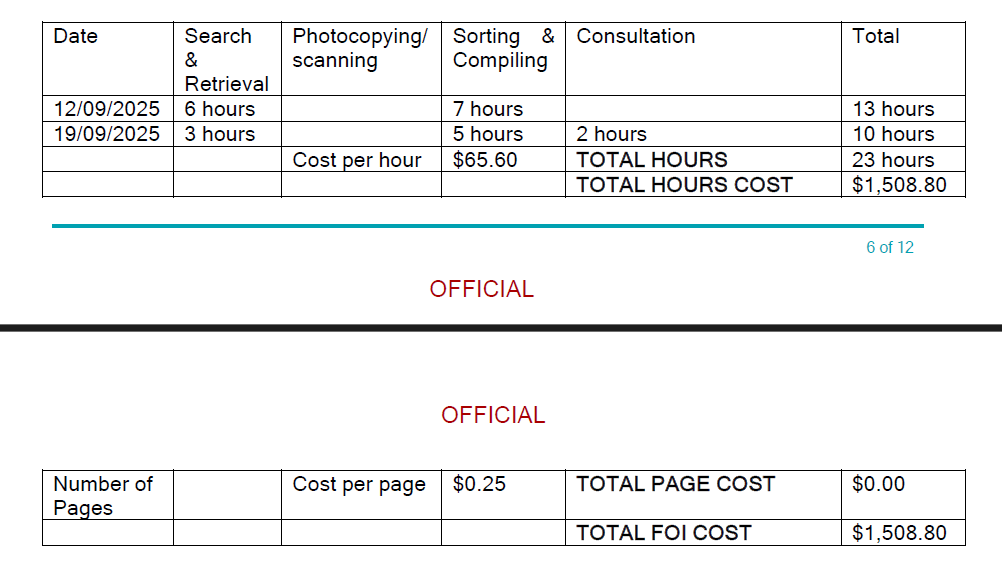
Naturally, the authorities disagreed, arguing that "if fees were waived for journalists in circumstances like the algal bloom, it is likely that the demand for information would become higher and higher", that scientists should be employed by the EPA should "focus their attention on scientific work and not on administrative work", and that "there are other methods to obtain information, via media request". It was a bold strategy of the agency, to say the least, but when it came down to it, the Office of the South Australian Ombudsman was unimpressed.
Here are a couple of choice lines from the decision:
- "I do not accept that opening 68 documents to determine whether they were related to the toxic algal bloom would have taken the 9 hours asserted by the agency. Having read the EIRA reports, many of them are short 2-3 page reports and the subject matter and date of the report is fairly easily identifiable."
- "In my view, sorting and compiling 15 emails is not a time-consuming task. I am also of the view that the applicant should not be penalised just because the EIRA system cannot produce succinct or fulsome reports."
- "The agency explained that the documents were reviewed and redacted but correctly noted that it was not permitted to charge the applicant for such.'
- "I cannot reconcile how once the 40 documents were identified that it would have taken 12 hours to sort and compile them in the manner described by the agency."
- "It is reasonably expected that as the lead agency responding to significant environmental risks or issues affecting the state of South Australia, it would be at the receiving end of the bulk of such FOI request."
- "The marine scientists were required to assist in the production of documents responsive to the application should be disregarded as a factor weighing against a fee reduction because the agency has a statutory obligation to respond to valid FOI applications, which may from time to time, require the knowledge and expertise of specialist employees to fulfil."
- "Media responses usually entail the production of vetted statements or general responses to questions, as distinct from documents that may contain the unvarnished and objective records held by an agency that can be obtained through the FOI process."
In this particular case, the agency succeeded in drawing out the process long enough to keep any information from becoming relevant to any story I have been working on. The important thing, for now, is that the decision recognises investigative journalism has some social value and recognition within administration law. If you have followed my work for any length of time, you should be aware that I consider South Australia to be one of the least transparent jurisdictions in the country, so in this context a win is a win. That being said, I have since filed a new external review with the South Australian Ombudsman, after the Department of Energy and Mining denied me access to materials on the basis that any information collecting in the course of administering the Energy and Resources Act was considered "confidential" and off limits. I don't have much hope of winning that fight, but you've got to try.
Good Reads
Because we here at Raising Hell know how much you love homework…
- This joint investigation by Drilled and ProPublica is the first in a series looking at the role of fossil fuel companies in shaping academic output over a a period of decades. This opening story has caused a story by finding that Wedges, a foundational paper that laid out potential responses to climate change, was financed and managed by BP.
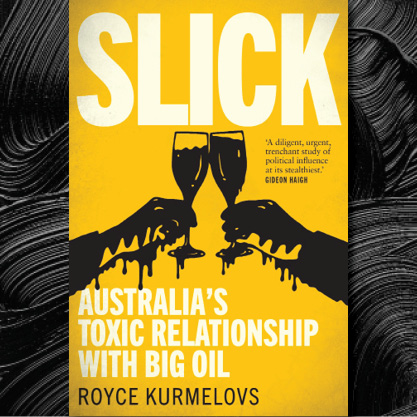
"Many books about climate change are worthy but dull. Slick, however, is as readable as it is shocking." - Richard Denniss, The Australia Institute, writing in The Conversation.
Reporting In
Where I recap what I’ve been doing this last fortnight so you know I’m not just using your money to stimulate the local economy …
- This last fortnight has been rocked with a hiccup on a major project. I can't talk about it just yet, but will give an update as soon as I am in a position to.
- 'Taxpayer-funded Australian sugar institute linked to abuses in West Papua' (Deepcut, 29 June 2026).
 Royce Kurmelovs
Before You Go (Go)…
- Want to get in touch? Message me on Signal at username RoyceK.11. Alternatively you can send hard copies to: PO Box 134, Welland SA 5007
- And if you’ve come this far, consider supporting me further by picking up one of my books, leaving a review or by just telling a friend about Raising Hell!