Issue 105: Burning On All Fronts
"Sometimes I feel like I’m being paid to curse in front of people who haven’t heard it in a while." - Anthony Bourdain, cook, writer, father, The New York Times, 8 June 2018
It's probably about time I shared some news. My public output over the last little while may have dropped off, but only because I've been busy setting up some larger projects in between chasing individual stories. The good news is that I am now free to talk about some of them.
The first, and probably the most immediate, is that some point in the not-too-distant future, I'll be headed to the Kimberley. In early June, the Walkley Foundation announced the 15 freelance journalists who received up to $10,000 to support work on a major project. The pitch was, essentially, to use this money to head out to northern Western Australia where the US oil company Black Mountain was planning to set up a fracking operation. The kicker is that this project would, essentially, be operating on the land around Noonkanbah Station. If you read my book Slick, that name should immediately jump out at you as the site of the first organised confrontation between an Indigenous community and an oil and gas company in 1980. The grant committee, apparently, liked what they heard. And so, in between all the other things I am working on, I now need to plan, research, and execute this ambitious field work in a far-flung region of the Australian periphery.
Speaking of the other things I have been working on, a few months back I was offered the opportunity to contribute an long essay to The Australia Institute's Vantage Point series, similar to the Quarterly Essay. Essentially, I was asked whether I'd like to write something to make sense of this apparent surge in support of Pauline Hanson. I said yes, on condition I can talk about the whole thing as the product of a new carbon politics. The essential idea has been taken from a lecture political economist and Brown University Professor Mark Blyth gave to the London School of Economics in January about the Trump administration, and a previous paper by Brown University Professor Jeff Colgan and his colleagues.
The gist of a "carbon politics" is that what we're watching play out globally right now is a clash between elites, with a counter-attack underway by those who draw their wealth, status and political support from carbon-heavy assets, broadly defined. If you have any interest in an exploration of these ideas at all, you can listen to my conversation with Mark Blyth at Drilled, and read the summary here (the interview is embedded in the text). The title of the essay, "Burning Down The House", is a direct reference to this lecture.
In attempting to frame what is going on, I put climate change at the centre of One Nation's political programme and sought to track how they have emerged out of the ashes of the Liberal Party. The first 26,000 word draft was knocked out over ten days in April, and it has gone through some revisions as events, my thinking, and feedback from a few select voices has advanced. I understand the essay will be out by November, at which point I'll be doing a lot of talking about it, including at the Canberra Writers Festival. I'll also be at the Byron Bay Writers festival this year, helping as a general hand and moderator, so I look forward to sharing that detail when the full program goes live later tonight.
On top of that, it is looking like I will also be making my way to Antalya, Turkey for COP31 in November where I'll be working as part of the team at Drilled and freelancing on the side for any Australian publications that may want to know what is going on. I say "looking" because, given the state of the world, there is always some measure of doubt until it happens. Having attended the previous meeting in Brazil as one of two Australian journalists on the ground, and a previous COP in Dubai, I am actually excited to keep covering this process. Whatever happens, or doesn't happen, I am curious to learn how this will all play out given the recent fossil fuel phaseout conference in Santa Marta, Colombia, the involvement of Chris Bowen as head of negotiations, and the global political environment. I am, of course, highly aware of the criticism and cynicism about the forum, and the process, but it does remain the only global vehicle for policymaking on climate change we currently have—and I continue to believe that climate change is currently the biggest story going, globally.
There's also been a few other bits and pieces too, most of which I'm not ready to talk about. I've been working on a few projects heavily reliant on Freedom of Information (which is why they're taking so long), including a fierce challenge to a knock back to one request involving records related to wide-spread flooding in the South Australian outback last year. I've also been helping out with the good people at the University of Adelaide to design next year's investigative journalism program, a task I take very seriously, and one I would actually like to talk about in the future, as teaching a thing forces you to carefully think through how you do a thing. In addition, I have a couple of interesting stories cooking with Drilled and a few other outlets in the short term. The demands of managing all these different bits and pieces has, however, meant I have increasingly been working weekends and odds hours, to the point where work has eaten away at my personal life. As a result, I've also been trying to enforce some constraints that normal, gainfully employed people enjoy—not that I am ever all-that successful.
I also want to end by saying that many of these projects could not happen without the support of generous and ongoing financial support of paying subscribers to Raising Hell. The money you have contributed goes into a fighting fund that I have been using to cover expenses on many of these projects. Often, this will involve paying substantial sums to access documents (pending an appeal), and my time spent working on things that I am not otherwise being paid for. These lines of inquiry don't always go anywhere—if I run something down and it does not stack up or check out, you will never about hear it because it's just not a story worth telling—but investigations take both time and money. Your contribution enables both. So, on that note: thank you.
Good Reads
Because we here at Raising Hell know how much you love homework…
- Former Exxon CEO Lee Raymond is to climate change what Henry Kissinger was to international relations. Now, Bloomberg reports, Raymond is dead, too.
- As a journalist, I came to climate and environment reporting by accident and from an odd direction: thinking about climate change as a product of the interaction between class, finance, heavy industry and corporate greed. This has meant I have often overlooked or not paid attention to the crisis in biodiversity and nature which is also unfolding at a horrifying pace, and why I appreciated this story from NPR about what happened when Britain reintroduced beavers.
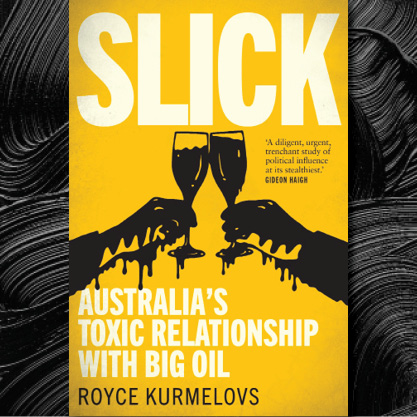
"Many books about climate change are worthy but dull. Slick, however, is as readable as it is shocking." - Richard Denniss, The Australia Institute, writing in The Conversation.
Reporting In
Where I recap what I’ve been doing this last fortnight so you know I’m not just using your money to stimulate the local economy …
- "‘Show us some fin’: citizen scientists take to the seas for first of its kind dolphin census" (The Guardian AU, 2 June 2026).
- "Driving an EV for the first time: what Australians need to know about charging, costs and batteries" (The Guardian AU, 13 June 2026).
Before You Go (Go)…
- Want to get in touch? Message me on Signal at username RoyceK.11. Alternatively you can send hard copies to: PO Box 134, Welland SA 5007
- And if you’ve come this far, consider supporting me further by picking up one of my books, leaving a review or by just telling a friend about Raising Hell!