Issue 109: Australia Really Wants A Transnational Carbon Trade
“In fact, I hate tree huggers,” - Sir Keir Starmer, former UK Prime Minister, reported in The Telegraph 10 July 2023, quote denied by unnamed Labor sources.

About an hour after this email lands in the inbox of Raising Hell's subscribers, representatives from Australian state and territory governments will sit down for an online meeting with the federal government to flesh out future rules governing how the country intends to go about importing waste carbon pollution from Singapore to stash beneath the seabed.
These meetings mark the latest in a long-running process by which Australia, Japan and other South-East Asian governments are attempting to set up a regional, transnational trade in carbon dioxide. The basic idea is simple enough: Australia sends gas to Japan, Japan re-sells that gas, Japan buys back the CO2 waste from industrial processes and ships this back to Australia where it is then stored in the ground or offshore beneath the surface of the ocean using Carbon, Capture and Storage (CCS) methods. The whole thing will be overseen by various trading houses, investment banks and brokers in the carbon trapezium between Sydney, Perth, Singapore and Tokyo, who will make out like bandits.
Even assuming the technology can work at scale—a fairly heroic "if" given the difficulties at facilities like Gorgon and the general awareness within the global oil and gas industry that CCS was really just a convenient way to get more juice out of the ground—there is much that can wrong in the process. For starters, CO2 is corrosive to certain grades of metal and pipelines can rupture, flooding the nearby area with a cloud that suffocates anything that enters it. When it comes to the seabed, geological processes can crack previously stable formations, turning that patch of ocean into soda and releasing stored CO2 back into the atmosphere. Once in the atmosphere, that gas will continue to alter atmospheric chemistry and contribute to the existential threat of climate change. And this is before considering more human-scale problems, like legislated liability waivers giving oil and gas companies a get-out-of-jail-free card to escape decommissioning fees on old infrastructure, despite stern warnings from authorities that business better behave.
Given the above, and the general hostility among environment and climate groups expanding CCS operations generally, it is little wonder then that authorities have been very quiet about their ongoing negotiations with Singapore to establish a bilateral treaty that would stand up the transnational trade. According to the meeting invitation, which Raising Hell was sent, the meetings to take place on Tuesday "build on previous discussions and provide an update on transboundary CCS", and to discuss a recently released consultation paper on the issue.
"In addition to providing an update on negotiations, we welcome feedback on key issues that need to be considered, e.g. regarding operational arrangements, regulatory requirements, economic opportunities, environmental safeguards, and potential impacts on communities and industry," the invitation said.
The consultation paper clearly outlines what is being proposed:
The Australian Government is working on a bilateral agreement (in this case, a treaty) with Singapore to put in place a framework to facilitate transboundary offshore CCS in a way that is safe, transparent, practical and consistent with international obligations. This is a commitment under Pillar 3: transition to Net zero under the Australia-Singapore Comprehensive Strategic Partnership 2.0, signed in October 2025. Under the bilateral instrument, Singapore would capture and export CO₂ streams to Australia, while Australia would receive and sequester the CO₂ streams offshore in sub-seabed geological formations in Australia.
The reference-free consultation paper makes interesting reading. Where once Barrow Island's Gorgon was the darling of CCS operations, the paper showcases the Norwegian Northern Lights project, another flagship CCS project backed by Equinor, Shell, and TotalEnergies. No mention is made of the technical and safety problems encountered by the project, identified by investigative journalists working with German newspaper Der Spiegal, nor their finding that the project captured 15x less than what it said it would. Neither is there any discussion about how industry has overstated the effectiveness of the technique, pretty much since day dot. There is similarly no mention of how, as ProPublica and Drilled reported, to handle the current CO2 waste humanity produces, the world would need to open a new CCS dumping site every four days, and these would have to be monitored indefinitely.
What the paper does do is promote this future transnational carbon trade as safer than oil and gas export, and uses Australia's existing Liquid Natural Gas (LNG) as a point of comparison. In a rare moment of caution, it does note that "new bespoke CO2 carrier vessels will need to be built and constructed for CO2 maritime shipping". Vessels in this design do exist, but not in the numbers needed. One count by ProPublica and Drilled put the number of operational vessels worldwide at three.
There are other interesting elements, too, such as the citing of the controversial Middle Arm petrochemical development outside Darwin as an example of how all that's needed to get CCS operations to work is scale. Middle Arm, for those unfamiliar, was initially sold to the public as something of a green-industry industrial hub. Ongoing investigation by the Environment Centre NT showed the project was being heavily promoted by lobbying firm Dragoman and drenched in gas, allegedly with a CCS-component. As per the consultation paper:
By creating shared infrastructure and enabling multiple industries to access low-emissions technologies, hub and cluster models can improve the commercial viability of decarbonisation projects, reduce costs through economies of scale, and accelerate the deployment of CCS and clean energy technologies.
The most interesting bit, however, appears at the end where the paper seeks to frame the agenda for meetings like the one this morning with various state and territory authorities. The first reads: "What are the expected or anticipated impacts to you or your community of any of the elements in the proposed bilateral instrument with Singapore for transboundary offshore CCS?"
At no point does it ask for critical feedback or concerns, though it does ask for proposed solutions to any concerns. On the one hand, this framing reinforces the kind of "positive thinking" that tends to plague Australian government decision making. On the other, it is a signal that those overseeing these negotiations are treating the emergence of a transnational carbon trade as a foregone conclusion. Though this particular treaty concerns Singapore, which is the gateway through which Australia's oil and gas trade flows, in the bigger picture, it suggests things are moving a step closer to the creation of a massive intra-regional trade in carbon that Australia and Japan have long sought. Assuming, of course, that everything works as intended.
Good Reads
Because we here at Raising Hell know how much you love homework…
- Adam Mastroianni writes in his newsletter that the defining quality of significant artwork is "thickness", something that AI-generated slop can't deliver.
- If you aren't following Peter Milne over at Boiling Cold, you should. He has been doing some excellent accountability journalism out west, including tracking the fundraising efforts to support the campaign of political hopeful Georgia Tree, a former staffer to Madeleine King and an employee of Woodside in its government-relations team.
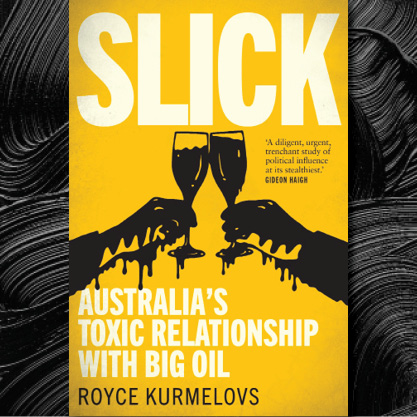
"Many books about climate change are worthy but dull. Slick, however, is as readable as it is shocking." - Richard Denniss, The Australia Institute, writing in The Conversation.
Reporting In
Where I recap what I’ve been doing this last fortnight so you know I’m not just using your money to stimulate the local economy …
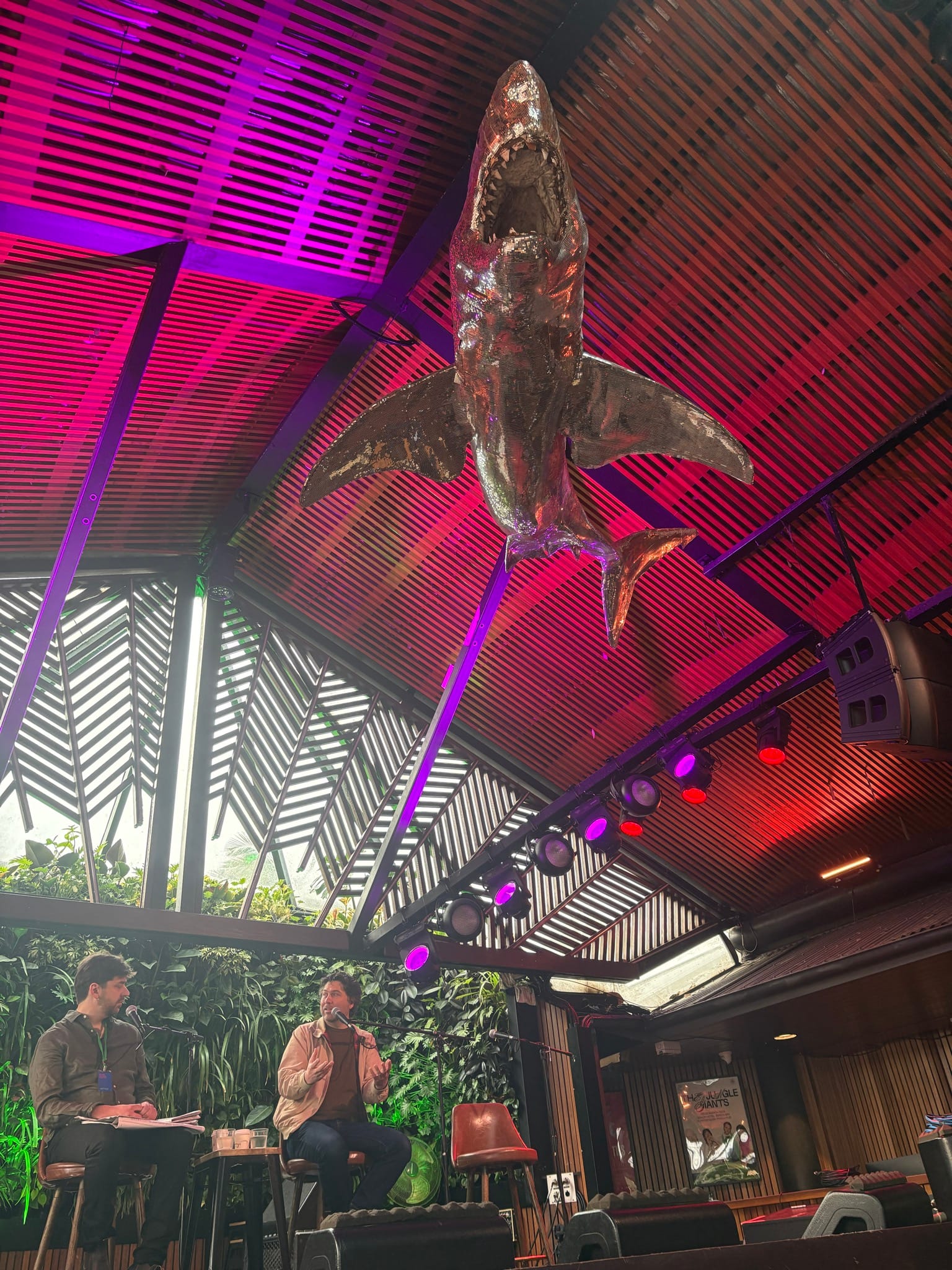
- The highlight of the last period was Byron Writers Festival, where I chaired a session with Marian Wilkinson about her recent essay Woodside v The Planet. I also hosted two sessions discussing current affairs on the Saturday and Sunday mornings that were something of a riot. After torrential rain forced the partial-cancellation of the festival last year, it was good to be back—and this time under the disco shark.
Before You Go (Go)…
- Want to get in touch? Message me on Signal at username RoyceK.11. Alternatively you can send hard copies to: PO Box 134, Welland SA 5007
- And if you’ve come this far, consider supporting me further by picking up one of my books, leaving a review or by just telling a friend about Raising Hell!