Issue 102: All Quiet On The Climate Front
"Nothing would please me more [than to expel the Americans], but who else would pump the oil that we need? God damn America." - Muammar Gaddafi, Libyan military officer, revolutionary and dictator, 2 April 1973.

I probably shouldn't have been so quick to shoot from the hip, but the question is one of those that bothered me: why isn't climate change more of a political issue right now? It's not as if the problem has gone away, so why aren't we talking about it? It bothered me for the same reasons why I was bothered by commentators in the United States asking why there were no protests from the anti-war movement over the country's war of aggression against Iran: all the activists are in jail or are on their way to jail over their protests against Gaza, their universities were defunded and people were chased out of jobs for daring to defy power. Why would they do that again?
 Albert Pinto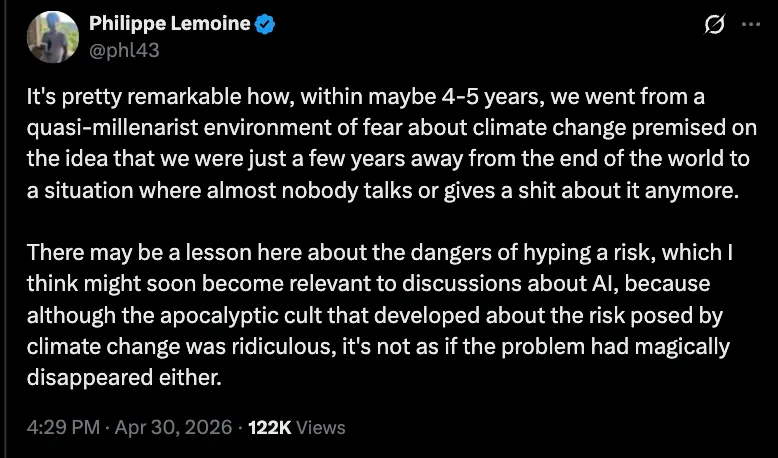
My reaction—annoyance—is not a knock on The Polycrisis team, whose work I have been following and who have to pose the question for rhetorical reasons. It does, however, speak to something I have noticed more broadly about erudite figures whose job is to make sense of the world for other people: they tend to miss a trick or two when it comes to the messy, cynical world of power and politics. By "politics", for what it's worth, I do not mean the capital "P" politics of nations, parliaments, parties, the machinery of government and smoky backrooms, but rather, little "p" politics: the web of power relations that govern every arena of life and, in particular, the effort by activists—politicians with no electoral mandate—to influence these dynamics to change the direction of Big "P" Politics.
In the social sciences there is a concept known as the radical flank effect. The short version of this, is that every movement needs its militants and militant groups to be successful. These radical fringes can be self-destructive when they act in ways that undermine the goals of the overall movement or cannibalises momentum, but they are midwives to change. The more these individuals and groups actually threaten the status quo, the more negotiating power moderate individuals and groups have. There are several classic examples of this, from the union movement to the U.S. civil rights movement, but a more recent example today is the international reactionary movement that has taken power in several countries. Over the last couple of decades, right-wing radicals have simply refused to compromise and demanded ever greater concessions from the centre, which has repeatedly struck these bargains in an effort to maintain a sense of normalcy. The result of this maximalism has been figures like Victor Orban, Nigel Farage, Jair Bolsonaro and, yes, Donald J Trump.
On climate change specifically, there is no denying there has been a determined and organised campaign to imprison climate activists, defund and sue climate organisations, promote climate deniers, sack climate scientists, fund climate denying media, and back-in the opponent of any political leader who makes the issue too much of a priority. Beginning with the Standing Rock Protests in the U.S., and the Just Stop Oil movement in the United Kingdom, governments the world over have been moving to protect and coddle fossil fuel companies, whether from legal liability or the risk associated with their investments. In the U.S. in particular, the Trump administration has been pursuing what it calls "energy dominance", a strategy that involves using the raw power of the state to put the brakes on transition, strand green assets to buttress fossil fuel production and coerce sovereign countries to keep them hooked on oil, gas and coal. Have a listen to my conversation with political economist Mark Blyth about this over at Drilled for more on this.
Yes, activists are annoying, factitious and the language of activism on the left can be dramatic and over-the-top, but the whole point of repression is that it is difficult to change the world from inside a jail cell. This is especially true when the target is fossil fuel production and consumption, and the vast oceans of money associated with the complex infrastructure needed to drill it, pump it, process it, pack it, ship it, load it, and burn it. It is also true that, in addition to this repression, many of those associated with climate activism have been somewhat distracted. Many have shifted focus to Gaza on the understanding that the causes are inextricably linked, that there can be no global settlement on climate change if an entire people can be erased because we now live in a nihilistic world of no rules where "might makes right".
It is also a little unfair to say that discussions of climate change have fallen away completely. Just in the last couple of weeks there have been a flutter of headlines that have put the subject back on the agenda. France has used the global fossil fuel crisis caused by the attack on Iran to announce a plan to electrify the entire country by 2050 with an additional €10bn a year in funding to help people transition. Last week, 57 countries attended the world's first conference dedicated to planning a phaseout of oil, gas and coal. These represented over a third of the global consumption of fossil fuels—though even as countries like The Netherlands made a big show of support, back at home the Dutch government sought to appeal court decisions in a way that would soften its obligations to act. Australia, for its part, sent senior officials but no minister. Closer to home, even after the meeting concluded on a somewhat hopeful note, Australia had nothing to say. There was no press release, no announcement or public discussion about the conference and its conclusions, of which Australia was a founding signatory. Go figure.
Why has climate change slipped down the domestic political agenda in many countries around the world? Why do political leaders seem not to care? The answers to these questions should be obvious: there is no good reason to discuss the issue, and a thousand painful reasons not to. And the good news for most political leaders is that everyone who might want to change that calculus is either in jail or on their way there.
Good Reads
Because we here at Raising Hell know how much you love homework…
- Magnus Lovold, writing in his newsletter, All Systems Go, has a balanced and critical look at what happened, or did not happen in Santa Marta, Colombia.
- Ketan Joshi has been taking aim at AI and data centre construction of late, but has this great long-read about how the backlash against the long-march of the Tech Industry parallels the backlash against offshore wind—and how they're the same.
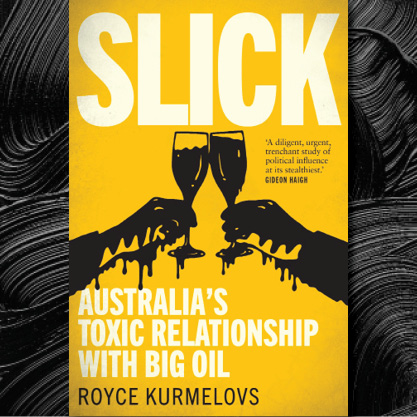
"Many books about climate change are worthy but dull. Slick, however, is as readable as it is shocking." - Richard Denniss, The Australia Institute, writing in The Conversation.
Reporting In
Where I recap what I’ve been doing this last fortnight so you know I’m not just using your money to stimulate the local economy …
- I've been busy this last fortnight with a couple of stories filed. Unfortunately none of them have gone to press at this time, so I can't share but there's quite a bit going on back-of-house that I look forward to sharing.
Before You Go (Go)…
- Want to get in touch? Message me on Signal at username RoyceK.11. Alternatively you can send hard copies to: PO Box 134, Welland SA 5007
- And if you’ve come this far, consider supporting me further by picking up one of my books, leaving a review or by just telling a friend about Raising Hell!