Issue 103: The Right's Big 'Mission Accomplished' Moment On RCP8.5
"It doesn't matter whether the cat is black or white, as long as it catches mice." - Deng Xiaoping, speech at the Communist Youth League conference in July 1962.

Climate deniers have been making a big deal about RCP8.5 for a long time now, but since it was announced the climate scenario will be retired, there was already rumblings on the weirder corners of the internet that something was afoot. The US-based, Atlas Network-aligned thinktank American Enterprise Institute (AEI) has been banging on about it for sometime. Over the weekend, The Australian followed, running a long, stand-alone report and associated editorial celebrating its end, and suggesting US President Donald Trump had imposed a "reality check" on "the politics of climate science". Not longer after, Trump himself weighed in on social media to say "good riddance" to the worst case scenario for climate change:
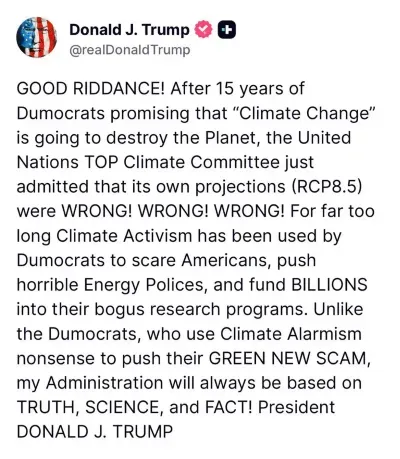
To most people, all of this is so niche it will read like the incoherent ramblings of an old man and a decaying brain. The scenario known as "Representative Concentration Pathways 8.5", or "RCP8.5", belongs to a boring corner of the international climate science and diplomacy world that most people will generally go their whole lives without ever needing to engage with directly. RCP8.5 is the dull name to very boring modelling of one potential future among several included in regular reports produced by the Intergovernmental Panel on Climate Change (IPCC). These IPCC reports are sprawling documents, the accumulation of vast sums of scientific data and knowledge, examining how the chemical composition of the atmosphere is changing as humanity continues to burn vast amounts of oil, gas and coal. The language used within these pages are often arcane and confusingly phrased in terms of probability. This is true even where they aim to be written in plain English, thanks to the technical nature of the exercise, and the inherent scientific limitations associated with analysing the mechanics of the vast, complex system that sustains all life on this planet.
RCP8.5 is commonly known as the "business as usual" scenario. In so many words, it outlines what a 'do nothing' future would look like, one where humanity happily continues to operate all the infrastructure needed to transfer vast oceans of hydrocarbon into the atmosphere. The current 'controversy'—if you can call it that—involving the scenario stems from a conversation between climate scientists that began around 2017. The question was whether, given that the world is actually attempting to move away from burning oil, gas and coal, the scenario is even needed any more. Of course, what began as a good faith question posed by scientists attempting to engage with, and respond to, new evidence, was soon picked up as a target for bad faith actors attempting to use the scientific process against itself for political ends. As an 'issue', it came to prominence around 2020, after two academics published an editorial in Nature questioning the usefulness of RCP8.5. Groups like the Atlas Network-aligned American Enterprise Institute picked up the thrust of the argument as proof all this climate stuff was just panicked alarmism by hysterical greenies trying to make good, red-blooded, gas guzzling folks the world over ride segues and become vegetarian or something.
 Nick Lutsko
The scientific reasons why the scenario continued to be included up until recently are complex, but can be boiled down to insurance. Worst case scenarios are useful as benchmarks to allow progress can be measured, but RCP8.5 itself functions as a something of planning tool. For example, if you were to rely on any other scenario from the IPPC because you thought it was more likely, but this assumptions it relied upon ended up being wrong and the real-world result was actually worse than anticipated, planning with RCP8.5 in mind means you have already accounted for the worst of all possible worlds. In other words: it's like being told by the doctor that your treatment to date means you aren't going to die, but they may still need to amputate if it fails. Living that possible future would not be ideal, but the fact you have accounted for it, means it's not as much of a catastrophe as winding up there with no plan at all.
It should be obvious why all this makes a good target for those more interested in power than science. If you stop people thinking about the worst case scenario, you remove an important organising tool that may actually galvanise people into action. If you've ever tried to get several drunks to agree on a place to get dinner in a foreign country, you'll understand the basic principle. The task becomes much easier if you all have a pretty good idea what time things close, but without that information, perspectives tend to diverge pretty quickly. As the night wears on, you're increasingly at risk of being left rolling the die on gas station tacos. Earlier attack on RCP8.5, which were largely unsuccessful, would have had this sort of effect as removing it would have made it harder to understand the nature of the problem we are dealing with.
The reason why it is getting attention once again is that it was recently announced RCP8.5 will be retired from future IPCC reports because real world progress meant an unlikely scenario was now so unlikely it wasn't worth considering. Naturally, those whose business is to sow fear, uncertainty and doubt about climate change and efforts to address it have leapt upon the development. Search Google News for "RCP8.5" and you will find a string of dispatches mostly from AEI's blog making a big deal about the announcement, leading up to Fox News coverage of Donald Trump's gloating social media post. All of this should be painfully silly to anyone who took two minutes to understand what was going on. Future IPCC reports will still include other high emissions scenarios which predict a catastrophic 3C of warming by 2100, a temperature band human civilisation has never existed within.
 Peter Hannam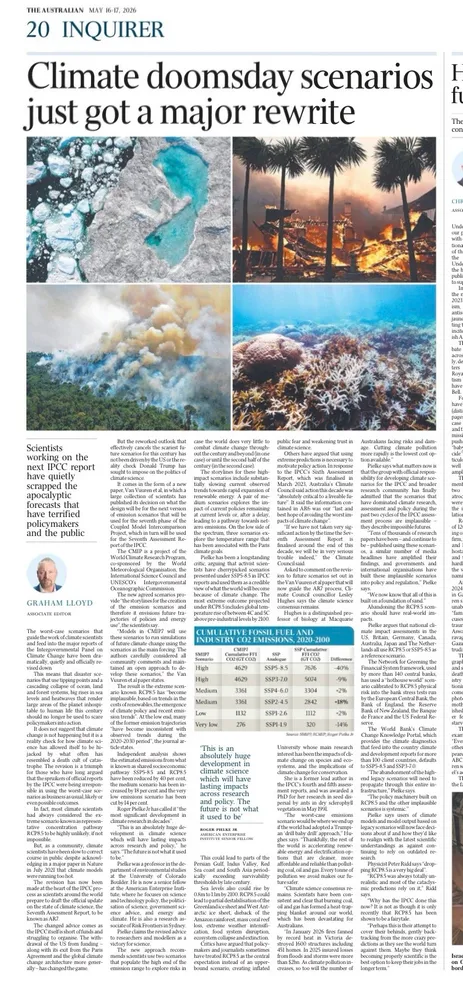
So why are the climate deniers and the political right celebrating? The answer is politics. To those who never liked all this climate mumbo jumbo, the message they are now sending is, essentially, "job done". We have, allegedly, avoided the worst of climate change, so by implication, we don't have to go as hard or as fast on climate change any more—or at all. Humanity can go on burning fossil fuels forever and all the asset holders can stay rich.
This appeared to be the subtext of recent, sprawling coverage offered of RCP8.5 by The Australian which presented concerns about catastrophe climate change as always overblown. In its standalone report, the paper's environment editor, Graham Lloyd, 'balanced' input from the Climate Council's Leslie Hughes by going so far as the United States of America to seek out the opinion of Roger Pielke Jr, a senior fellow at the Atlas Network-aligned American Enterprise Institute and self-described "climate heretic". Pielke is a trained scientist who says he accepts the science of climate change, but rejects any link to extreme weather. His public advocacy resembles the pattern of scientists associated with the American Enterprise Institute who collaborated with the tobacco industry in 1990s. Pielke, who was quoted by The Australian as describing international climate architecture as being "built on a foundation of sand", was given the last word on the story. The associated editorial complained how RCP8.5 had been used "to scare a generation of youth and politicians" about the climate crisis.
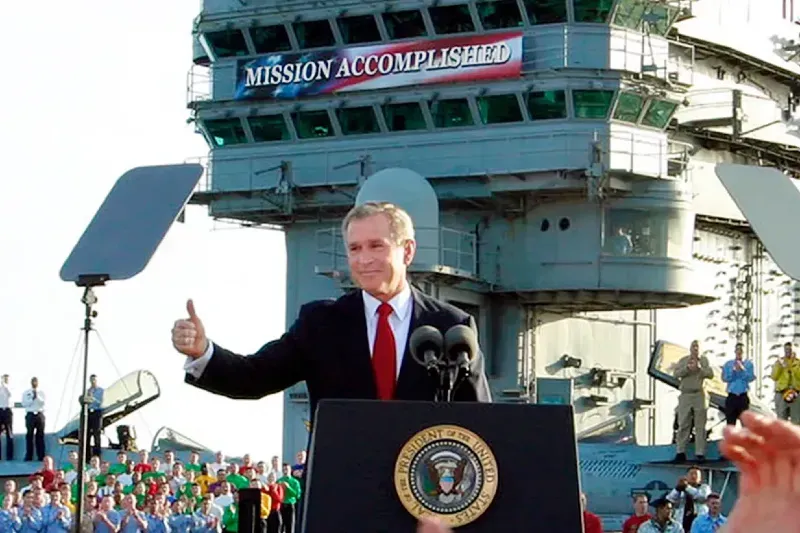
All of which is to say that this moment, with its "mission accomplished" energy, is very on brand for the political right in the United States and its international counterparts with whom it coordinates. It shouldn't be forgotten that Donald Trump promised his war of aggression against Iran would be an $11.3bn six-day excursion but right now the US navy is stuck floating outside the Strait of Hormuz as a global fossil fuel crisis threatens the world economy. The conflict remains unresolved despite multiple promises that a deal is near as Trump's approval ratings continue to plummet ahead of the mid-terms. Much like George W Bush declaring victory as he stood on the deck of an aircraft carrier off the coast of California, it may prove dangerous for anyone who seriously thinks it "mission accomplished" on climate change.
Good Reads
Because we here at Raising Hell know how much you love homework…
- Jason Burke has this powerful story for The Guardian about the effort to save records from Gaza ahead of the total destruction of The Strip.
- Amy Remeikis at The New Daily has an editorial pretty much summing up my thoughts on the tactically-clever, but strategically flawed budget—and the right wing's sudden freakout over communism.
- If there is an air of unreality at the moment about the US and Israel's war on Iran, take a moment to read this report from Bloomberg on what analysts are thinking about global oil supplies—and the heroic assumptions they are making.
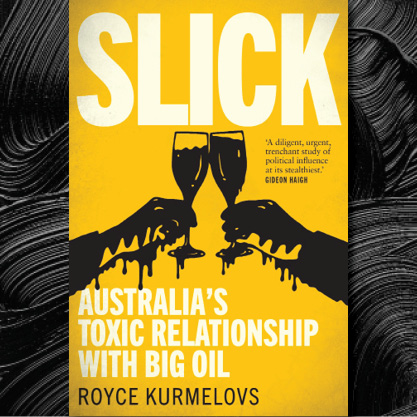
"Many books about climate change are worthy but dull. Slick, however, is as readable as it is shocking." - Richard Denniss, The Australia Institute, writing in The Conversation.
Reporting In
Where I recap what I’ve been doing this last fortnight so you know I’m not just using your money to stimulate the local economy …
- ‘Australian Oil and Gas Company Santos Offered Communities Help in Exchange for Good PR' (Drilled, 11 May 2026).

- ‘"Floats above the landscape": the architect whose designs touch the earth lightly' (The Guardian, 15 May 2026).
 Royce Kurmelovs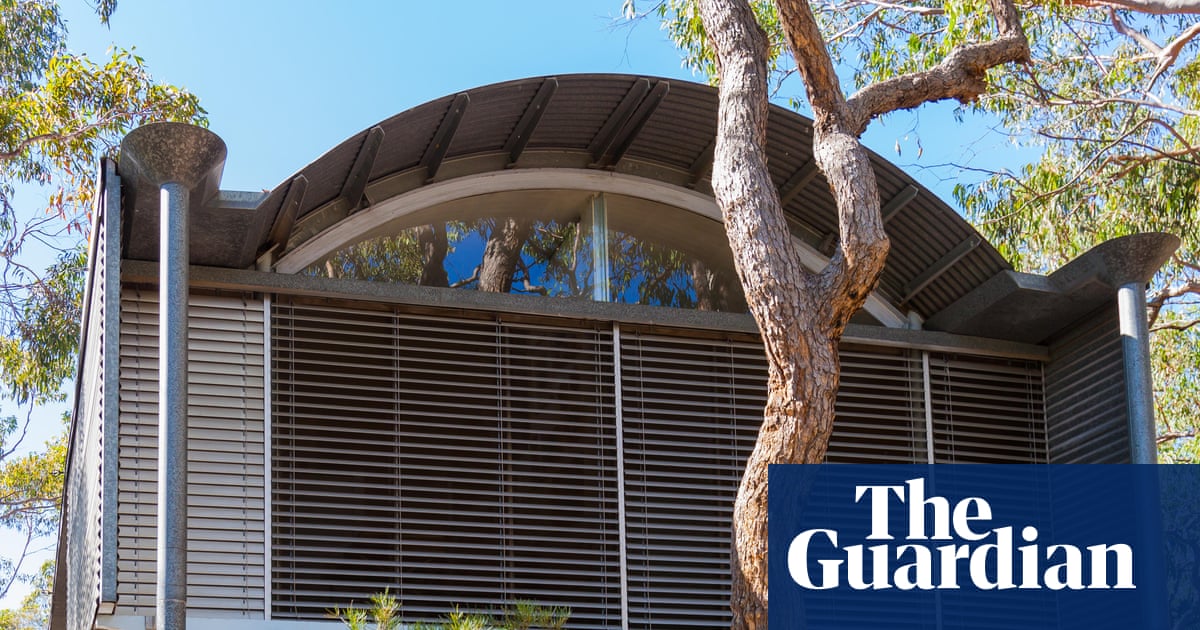
- ‘Why Australia's leaders are avoiding a gas tax' (Deepcut, 19 May 2026).
 Royce Kurmelovs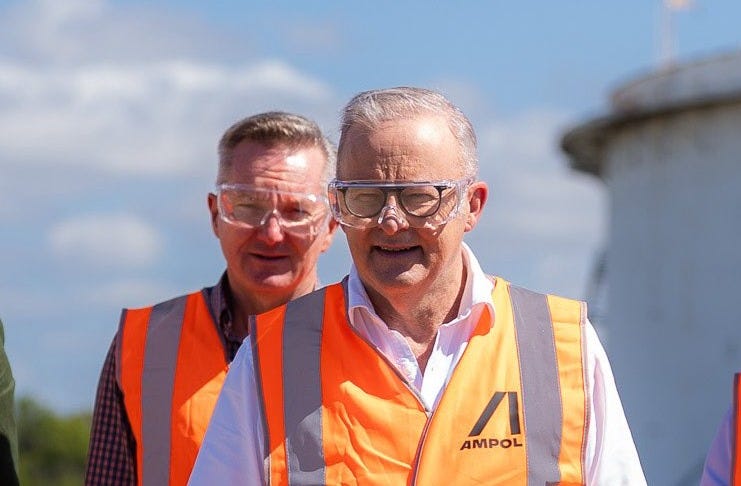
Before You Go (Go)…
- Want to get in touch? Message me on Signal at username RoyceK.11. Alternatively you can send hard copies to: PO Box 134, Welland SA 5007
- And if you’ve come this far, consider supporting me further by picking up one of my books, leaving a review or by just telling a friend about Raising Hell!