Issue 104: Violet CoCo On Gaza And Climate Change
'We should never forget that everything Adolf Hitler did in Germany was "legal" and everything the Hungarian freedom fighters did in Hungary was "illegal."' - Dr Martin Luther King Jr, Letter from Birmingham Jail 1963

On Monday last week, the Australian activists who joined the latest flotilla seeking to break the blockade of Gaza, and who had been detained by the Israeli military as a result, returned to Australia. Among them was Violet CoCo, whose activism around climate change had brought her to national prominence. Violent kindly agreed to speak with me about her experience and the relationship between climate change and the Israeli militaries destruction of Gaza. Below is a selected transcript of our conversation. The transcript has been edited for length, clarity and brevity, with some portions omitted to keep it to under 900 words. Any errors are my own.
Royce Kurmelovs: Can you explain a little about what happened?
Violet CoCo: Yeah, so recently I was a part of the Freedom Flotilla Coalition and Global Sumud's attempt to break Israel's illegal siege on the Palestinian people, which is causing a starvation of their population. We were intercepted in international waters, kidnapped at gunpoint, and held on a prison ship, which many have compared to a concentration camp. I personally was beaten, tortured and sexually abused, along with many other of my fellow humanitarian peace activists. In fact, it was actually part of the induction to the prison ship that we went through a torture chamber, that is how calculated the cruelty of Israel is.
RK: Can you explain more about what you mean by "torture chamber"?
VC: So on the prison ship, there was a configuration of shipping containers into a box, and that was like an open-air cell for over 100, almost 200, people that were on this particular ship. There were two prison ships. To move into the container prison, they pushed us into a shipping container with five Israeli soldiers in there, in the dark. They beat each one of us in turn, like in a production line, and sexually assaulted many of us, tasered some of us, and then ejected us into the container yard.
RK: You have been arrested something like 40 times in Australia and you've dealt with the Australian criminal justice system in one way or another. Do you have any observations?
VC: Because I have that experience, I was able to do a little bit better in the scenario, and you know I was able to keep our comrades singing. We sang "We Shall Overcome". That really helped keep the spirits high in between moments of uncertainty in terms of the level of violence and calculated violence. I know that in the southern colony, I have a lot more privilege, and there's a lot more accountability to my own well-being, because of my white privilege. I haven't experienced this same level of violence in the prison system here, but I know that others have. I know that while they don't necessarily beat into prisoners here in the southern colony, they do things like putting—I mean, obviously sometimes they do, we've had all the reports from First Nations people—but other weapons they use in the prisons here, is that they'll put people they want beaten into cells with volatile characters and use inter-prisoner violence to enact similar attitudes. This is because it's a colonial attitude. The only people who have worth are people with bank accounts, billions of dollars, companies and property. Those who call for justice and piece are subject to cruelty and oppression.
RK: How did the Australian government help?
VC: I mean, I'm still catching up on a lot of the news. I hear that Penny Wong had made a phone call. I hope her wrist is okay. I hear that she's maybe calling in the Israeli minister. They might have tea together. I don't know what's going to happen in that room, but I don't expect it to be enough.
RK: Most people out in the world will know you for your climate activism. Can you talk about the relationship between what's happening in Gaza and what's happening on climate change?
VC: The carbon footprint from the from Israel's genocide in Gaza exceeds 31-to-60 million tonnes of carbon dioxide equivalent. There's extreme air pollution, water and soil contamination, tens of millions of tonnes of debris, much of which is filled with unexploded ordnance, asbestos, and decomposing human remains. The genocide is the equivalent of running 84 coal power plants a year, and in the first four months, the emissions generated were more than 21 climate vulnerable nations combined. And 99% of these emissions are linked to Israel's aerial and ground attacks. We also see that, you know, obviously this is an ecocide. Trees and animals also don't like being bombed, and we know that Israel has intentionally destroyed ancient olive groves to plant their own trees in a project to completely wipe out the Palestinian existence and culture.
I think the relationship here is something that you really understand if you listen to Indigenous perspectives of what it is to be indigenous to a place, because that is to be connected to its ecology and be a part of that ecology's functioning. So, yes, ecocide and genocide run hand in hand. It has here in this colony, and it does in Palestine, because their way of life is intertwined with the natural environment. That's where they eat from, that's where you know they cultivate their beauty and their nature. So, yes, ecocide an essential part of this story.
RK: Is it possible to address climate change in any meaningful sense, if there is no international series of rules or laws that might constrain something like what's happened in Gaza, and the human rights abuses. I mean, is there a relationship there between these two issues?
VC: Absolutely, I think if we cannot control the military industrial complex's capacity to utterly destroy ecosystems and to use extraordinary emissions in their pursuit of wealth, we will all suffer the consequences. We cannot address climate change if we don't address Gaza. It is essential to the liveability of our planet.
Good Reads
Because we here at Raising Hell know how much you love homework…
- The Guardian and the ABC last week broke a major story about leaked internal files BHP that describe how the company essentially abandoned ambitious climate change related projects and hoped no one would notice.
- If you didn't catch it, it's worth listening to this interview with a man on social security who called into ABC Melbourne to explain how he had gone without food for three days and was drinking water to "feel full" because his employment servicers provider would not help. Note, the Australian government operates a fund so these organisations can help buy things like essential groceries, but there was $684m unspent in the last budget. The man's case worker, did, however, pray for him over the phone.
- The Columbia Journalism Review have a great piece about Hemingway's USD$187,000 expenses claim, his general ratfuckery and his larping as an infantryman during his attempt to cover the D-Day invasion in Normandy. If you want to know where the real action was, read Martha Gellhorn.
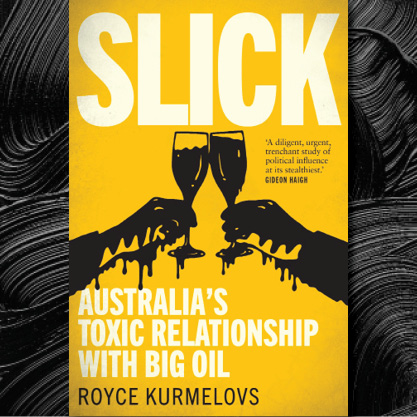
"Many books about climate change are worthy but dull. Slick, however, is as readable as it is shocking." - Richard Denniss, The Australia Institute, writing in The Conversation.
Reporting In
Where I recap what I’ve been doing this last fortnight so you know I’m not just using your money to stimulate the local economy …
- 'Power play: what to consider when installing a home battery in Australia' (The Guardian AU, 31 May 2026).
 Royce Kurmelovs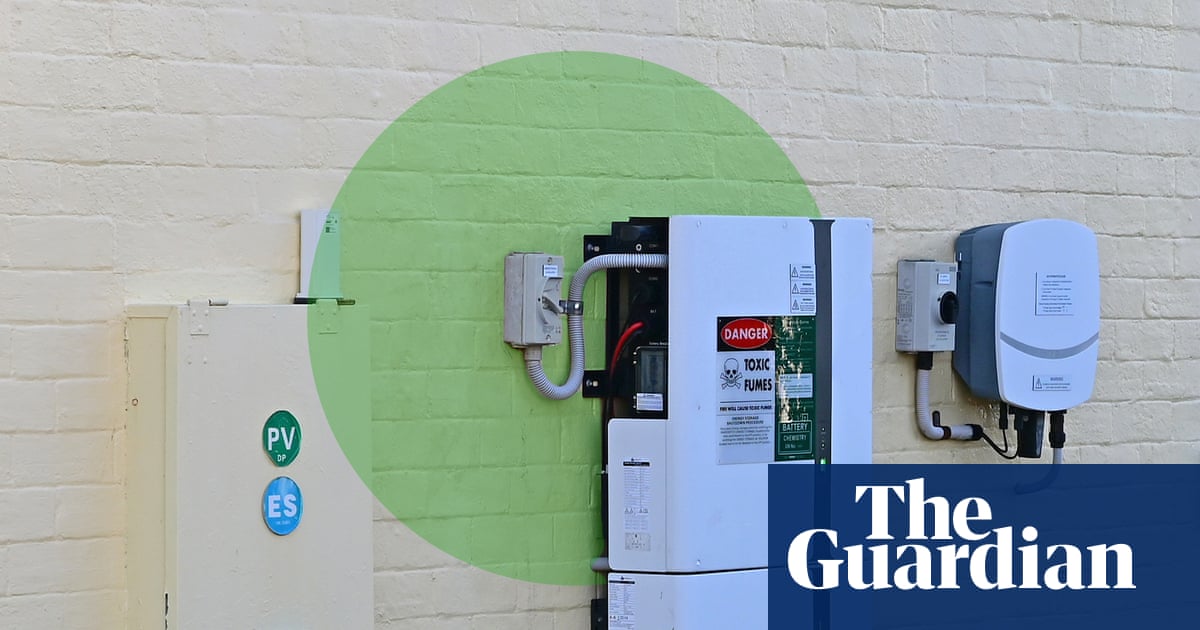
- Jo Dyer and David Milner of The Shot kindly invited me into The Shot last Sunday where we spoke about as much as we possibly could in the time allowed, including the revelations about BHP's attitude to climate change, the outgoing NACC Commissioner's performance during Senate Estimates and the possibility of a new Teal Independents Party.
Before You Go (Go)…
- Want to get in touch? Message me on Signal at username RoyceK.11. Alternatively you can send hard copies to: PO Box 134, Welland SA 5007
- And if you’ve come this far, consider supporting me further by picking up one of my books, leaving a review or by just telling a friend about Raising Hell!