Issue 111: Buy The Numbers
Two years ago I started researching another of those mysteries from an earlier era. It began, actually, with work on a separate job. A couple of French academics had published a journal article looking at Total Oil's historical contribution to the global campaign to frustrate climate science and efforts to address the problem. In doing so, they wrote briefly about how US oil giant Exxon had war-gamed scenarios during the early 80s to work out the best response if the world decided it wanted to do something about climate. As part of this work, the company sought to turn IPIECA, a vestigial group within the United Nations, into a vehicle to coordinate its campaign. The benefits of this were enormous for the oil industry. It its employees to attend United Machines under IPIECA badges, rather than having to identify themselves as working for an oil company. It gave them author, regular access to meetings and decision makers, and plugged them right into information flows from official processes.
When Amy Westervelt and I looked into this for climate-investigations organisation Drilled, I was a little surprised to find an Australian connection. The focus of our research was how IPIECA, as a glove-puppet for an assertive oil industry, had been instrumental in seeding the economic argument against addressing climate change. The group sponsored symposiums and built networks of influence figures to help hammer out why dealing with climate change should best be left to the free market and to plot out optimum scenarios that could be shared with policymakers when they were working out what they were going to do. Along the way, one name cropped up I did not expect: Brian Fisher.
Brian Fisher, for those unacquainted, has long been a bette noir for many in Australia who had worked in or around climate change. Dr Fisher had been the head of ABARE (pronounced A-BARE) through the nineties. The organisation served as something of a CSIRO of statistics, and at the turn of the new Millennium, the modelling work the agency churned out focussed heavily on the economic impact of addressing climate change.
To be clear, Fisher and his team were not the first to invent the idea of using economic modelling to examine the issues posed by climate change, but he was the first to put a dollar figure to how much it would cost to fix, right down to the last decimal place. This was a powerful innovation at the time, an advance in rhetoric around governance and policy that continues to be powerful today. A neatly drafted press release talking about how addressing climate change would smash farmers with a $600m bill in 1994 dollars, sitting atop a report number 200 pages with lots and lots of numbers, was both a conversation starter, and a conversation ender. Do something about emissions? Not at that price. What if we do something else? Something that isn't so... expensive—what if we just wait and see?
Thanks to the generous support of Raising Hell's paying subscribers, I have spent sometime over the last couple of years going back over once-confidential government records to look more closely at what happened at ABARE during this time. As ancient history, dating back to the early 90s, and work that is not ordinarily valued in Australia. This means it would not have been possible without contributions that helped fund flights, accommodation and the acquisition of thousands of pages of internal materials. What I have found during this research, I believe, is important for climate accountability and justice, in that it allows us to piece together what happened in a way that expands our understanding of who is responsible for what at this time—and how their influence continues to this day.
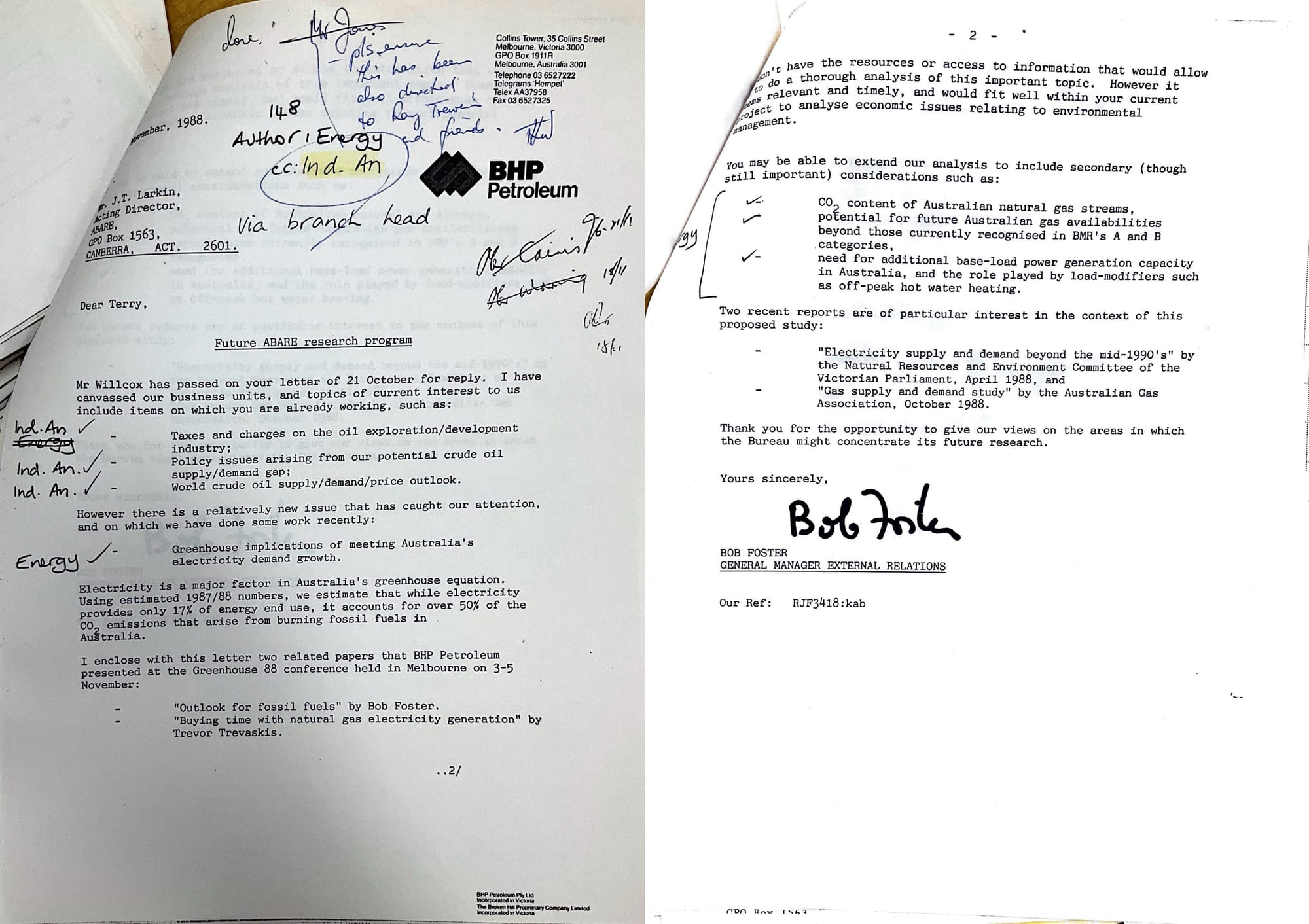
Much of the critical response to ABARE and its work over the years has focussed heavily on the detail of its modelling. What is remarkable about the ABARE story is the extent its early modelling efforts represent a crude, darker and inverted application of similar methods that, when applied to climate harms, have increasingly come to be used in the growing field of attribution science. These growing area of science is capable of discerning whether specific weather events can be linked to climate change. Rapid attribution studies very quickly attempt to determine this link and the proportion of humanity's contribution. The science has even developed to the point where it is possible to quantify the contribution of individual companies to climate impacts and make an estimate on the dollar figure associated with that contribution—with courts indicating they will accept the veracity of this work. ABARE's modelling deliberately avoided starting down this path. Neither the organisation nor the politicians it answered to saw profit in looking at climate impacts, as its work was far more useful to industry when used as a club. Putting a dollar figure to the cost of climate action allowed these companies and their friends in politics to shut down those who wanted to act on the problem early.
What I increasingly found as I sought to piece together what happened at that time, was a much larger story about ideas and who gets to make them. ABARE was only ever interested in one question—how much damage addressing climate change would do to the Australian economy. The questions I had were: How did this innocuous organisation once responsible for generating agricultural statistic come to churn out report after report on climate change? Who was responsible? Why did they do what they do?
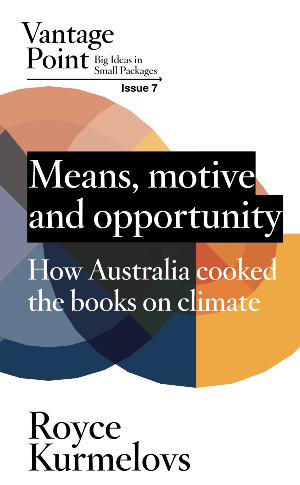
Through my research I would learn how it was not the product of a single conniving mind, but the convergence of several inputs, including ideology, political arrogance, financial pressure, careerism, personal ambition and cowardice. Some of this work has been published in piecemeal fashion with climate investigations organisation Drilled, but as of October 28, I will be publishing an essay published by The Australian Institute as part of their Vantage Point series that marries this research up, brings it into the present day and lays it out in a clear way.
This project is one of two essays I have been working on this year (the other one looking at One Nation and climate change, which is now slated for publication in February 2027). It is also something of an unusual project for me. Though it is built atop my journalistic output and research, an essay belongs to the world of analysis which is at once freeing and unnerving. There is also the reality that The Australia Institute was an antagonist to ABARE during the 90s. My research has both independently validated many of the criticisms levelled at ABARE by The Australia Institute's former executive director Clive Hamilton and others at the time, but also shows how the situation was far worse then they could have ever known.
Going forward, I plan to share a short excerpt of the essay for paying subscribers only as a thank you for your ongoing support. Though this is very much an Australian-specific story, for the handful of overseas subscribers, I would be happy to sling you a copy of the essay if you have any interest. For everyone else, please consider pre-ordering a copy either through your local independent bookstore, or direct from The Australia Institute. This is more important than you realise, as the success or failure of any major publication, be it book or essay, depends on sales in the immediate weeks following publication and pre-orders are increasingly playing a significant role in that process. These numbers shape what projects a publisher, especially publishers of non-fiction, will pursue into the future, meaning that within this short window, readers have significant power to decide what they want to see more of.
With that in mind, you know what to do.
Good Reads
Because we here at Raising Hell know how much you love homework…
- Brett McKay, working with the Investigative Journalism Foundation in Canada has a detailed report looking at the Albertan secession movement and how thinktanks associated with the Atlas Network are working to destabilise the country in support of Trump's agenda.
- Maggie Harrison Dupre and John Christian have this incredible investigation looking at an incredibly lucrative AI-slop business operated by three Australian brothers that buys specialist magazines and publications, guts them, then floods their websites with fake journalism.
- I thought this brief video essay by AnthroDorphins talking about the anthropology of "Mar-A-Lago face" is worth a watch.
"Many books about climate change are worthy but dull. Slick, however, is as readable as it is shocking." - Richard Denniss, The Australia Institute, writing in The Conversation.
Reporting In
Where I recap what I’ve been doing this last fortnight so you know I’m not just using your money to stimulate the local economy …
- Joel Jenkins of the Bogan Intelligentsia podcast had me on to talk climate change in the lead up to COP31 with the provocative question: is the world too broken for climate solutions? Listen here:
- Save the Date!
- 29 September 2026: Lyndal Rowlands and I will be talking about COP31 and climate journalism in an free event hosted by the Science Journalists Association of Australia. Register here. Trouble starts from 6pm.
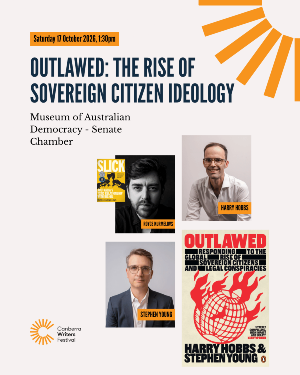
- 17 October 2026: I'll be hosting at session, Outlawed: The Rise of Sovereign Citizen Ideology, at Old Parliament House in Canberra on the Saturday. Get your tickets here.
- 18 October 2026: I'll be hosting another session, Wave of One Nation about (what else) the growing support for Pauline Hanson and friends. Get your tickets here.
- 28 October 2026: I have a new essay, Means, Motive and Opportunity, out through The Australia Institute's Vantage Point series. Pre-orders and sales in the first couple of weeks help make or break a project. Get yours here.
- February 2027!: I'll have ANOTHER essay out with Monash University Press looking at One Nation. Stay tuned for more.
Before You Go (Go)…
- Want to get in touch? Message me on Signal at username RoyceK.11. Alternatively you can send hard copies to: PO Box 134, Welland SA 5007
- And if you’ve come this far, consider supporting me further by picking up one of my books, leaving a review or by just telling a friend about Raising Hell!